

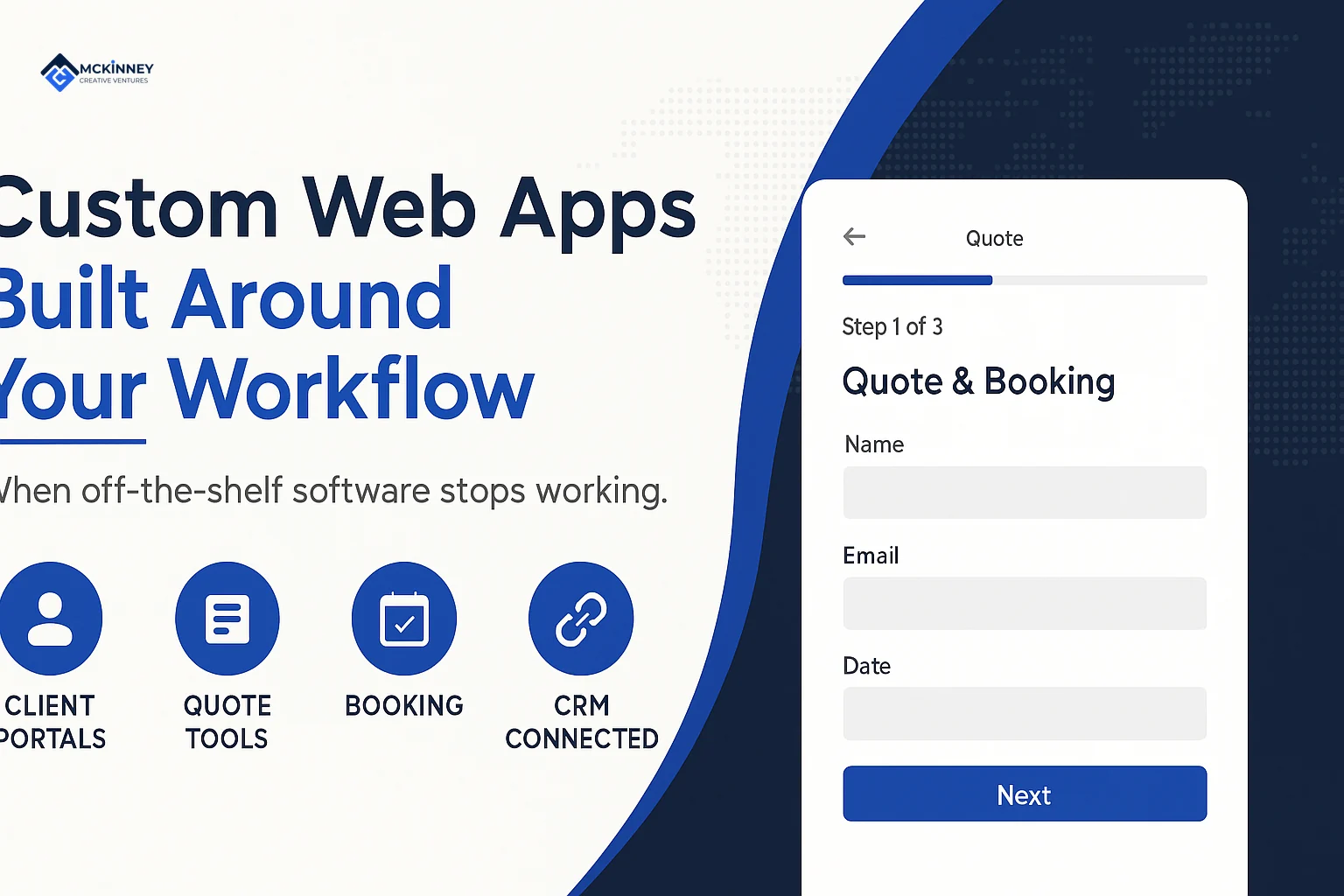
Custom web applications make sense for a small business when the software it already pays for forces staff to re-key data, cannot handle a quote or booking process the business actually runs, or cannot show customers information a page cannot. This guide is for owners in the Twin Cities, the St. Croix Valley and western Wisconsin deciding whether to build, and what to try first.
We build custom web applications as part of our website work, so we have a stake in the answer. For that reason we start with the cheaper options and say when they are enough. We give no price or timeline figure here, and we explain why in the scoping section.
What custom web applications are, and how they differ from a website
A website shows information. A web application accepts what a visitor enters and returns a result worked out for that person, such as a calculated quote, a booked time or a map result. It runs in a browser, so customers need nothing installed, and it can pass what it collects to the systems behind your business.
Our website design service describes the work as focused tools that quote, qualify, book, and guide customers, then connect the result to the system behind it. It names three kinds of build: a multi-step quote estimator, a booking flow that lets customers choose services and schedule across several service brands in one place, and a map that shows homeowners their local water quality and routes them to the right service. We list them as examples of the category. They promise no result for your business.
Signs that off-the-shelf software has stopped fitting
A tool that fits needs no workarounds. These are the signs we look for.
- Re-keying. Someone copies the same job details from a form into a calendar, then into an invoice, then into a spreadsheet.
- A process no plugin fits. Your quotes depend on rules, such as service tiers, distance or property type, that a generic form cannot apply.
- Information customers need that a page cannot show. A customer wants a result for their own address or situation, and today they have to call and wait.
- A queue behind a person. A customer cannot move forward until someone does arithmetic or checks availability.
In our experience, one sign alone rarely justifies a build, and two or three that cost real time every week warrant a closer look.
Custom web applications for small business: try the alternatives first
In our experience, many problems that look like missing software turn out to be unused settings, a missing connection or a poorly written form. Work through the options in this order.
Scroll to see all columns
| Situation | Try first | A custom build starts to make sense when |
|---|---|---|
| Job details are typed into several tools | Connect the tools you already own with an integration, so the entry happens once | No integration exists for the combination you use, or the rules in between are too specific |
| Quote requests arrive as vague emails | Rewrite the form so it asks the questions that decide the price | The price depends on a calculation the form cannot perform |
| Booking takes phone calls | Configure the booking feature in your current scheduling or CRM tool | Services, brands or crews need rules the tool cannot express |
| Customers ask for status or local information | Publish a clear page or a short update message | The answer depends on data specific to each customer or address |
In our experience, a configured tool costs less to start than a build, and upkeep stays with the vendor under its terms. Choose a build only when the limit is real and recurring. If a well-structured page would do the job, we say that, because a tool nobody needs is one more thing to maintain, and our modern website design guide covers what a good page contains.
What to decide before anyone writes code
Who owns the code and the data
Do not assume. The U.S. Copyright Office's Circular 30 on works made for hire, revised August 2024, says the author is ordinarily the person who actually created a work. It describes two situations where the hiring party is the author: an employee's work within the scope of employment, and a specially commissioned work that falls in one of nine listed categories and is covered by a written agreement, signed by both parties, that calls it a work made for hire. Circular 30 covers only works made for hire and does not address assignments or licenses. In our reading, that makes the written agreement the place to settle who owns the code and data. Put it in writing, including who holds the code, the data and the accounts, and have an attorney review it.
Where it runs and who keeps it running
Ask where the application is hosted, who pays for hosting, and who is responsible for updates, backups and fixes after launch. Our website service covers hosting and ongoing management, and the question to ask any builder is the same: what happens in month 13? Get the answer in the agreement.
How it protects customer information
A quote or booking tool collects names, addresses and phone numbers. The OWASP Top 10:2025 is a standard awareness document for developers on web application security risks, and its first entry is broken access control. You do not need to master it. Ask a builder how they handle the categories on it, such as access control, authentication and software supply chain failures, and treat vague answers as a warning.
How you get out
Ask for access to the source repository, written notes on how it works and a way to export your data. A build you cannot move is a build you cannot fix if the relationship ends.
How to scope a first version
Write the current process down step by step, including who does each step and how long it takes. Find the one step that costs the most or loses the most customers, and build only the tool that removes it. One job, one type of user and one connection to your existing system is a sound first version.
Then use it and measure it before adding anything. In our experience, extra features are easier to add to a tool people already use than to a large tool nobody asked for. We do not print a cost or a calendar estimate for custom applications, because both depend on the number of screens, the rules, the connections to other systems and how quickly decisions come back. Any figure in a general article would be a guess. A written scope from a builder should state the deliverables, the milestones and what is excluded.
What changes for a Twin Cities or St. Croix Valley business
Some East Metro service companies work on both sides of the St. Croix River, which means a booking or quote tool may serve customers in Woodbury and in Hudson under different state rules. A good intake step asks which state the job is in and applies the right information from there.
Licensing is the example we can source. Minnesota's Minn. Stat. 326B.87 says a licensee's license number must appear in advertising, which it lists as including websites and Internet ads, and that contracts entered into by a licensee must state that the person is licensed and give the number. The statute's definition of licensee is limited to specific residential license types, so other trades should confirm their own rules with the regulator. Wisconsin issues its own contractor credentials. The DSPS dwelling contractor page we read does not mention advertising, so ask DSPS what applies to a Hudson job.
In our reading, a tool that produces a proposal or a contract for a Minnesota licensee should be checked against both provisions. Whether a given screen counts as advertising or as a contract is a question for an attorney, and this is general information. It is not legal advice.
Here is an illustrative example. Thistlemoor Home Services is an invented company that books roof inspections in Woodbury and Hudson. Its booking tool asks for the property address first, shows the service area it covers, and attaches the correct license information to the confirmation. It does not touch the company's invoicing, which stays in the tool the office already uses. If you want to talk through where a tool would and would not help, you can contact us.