
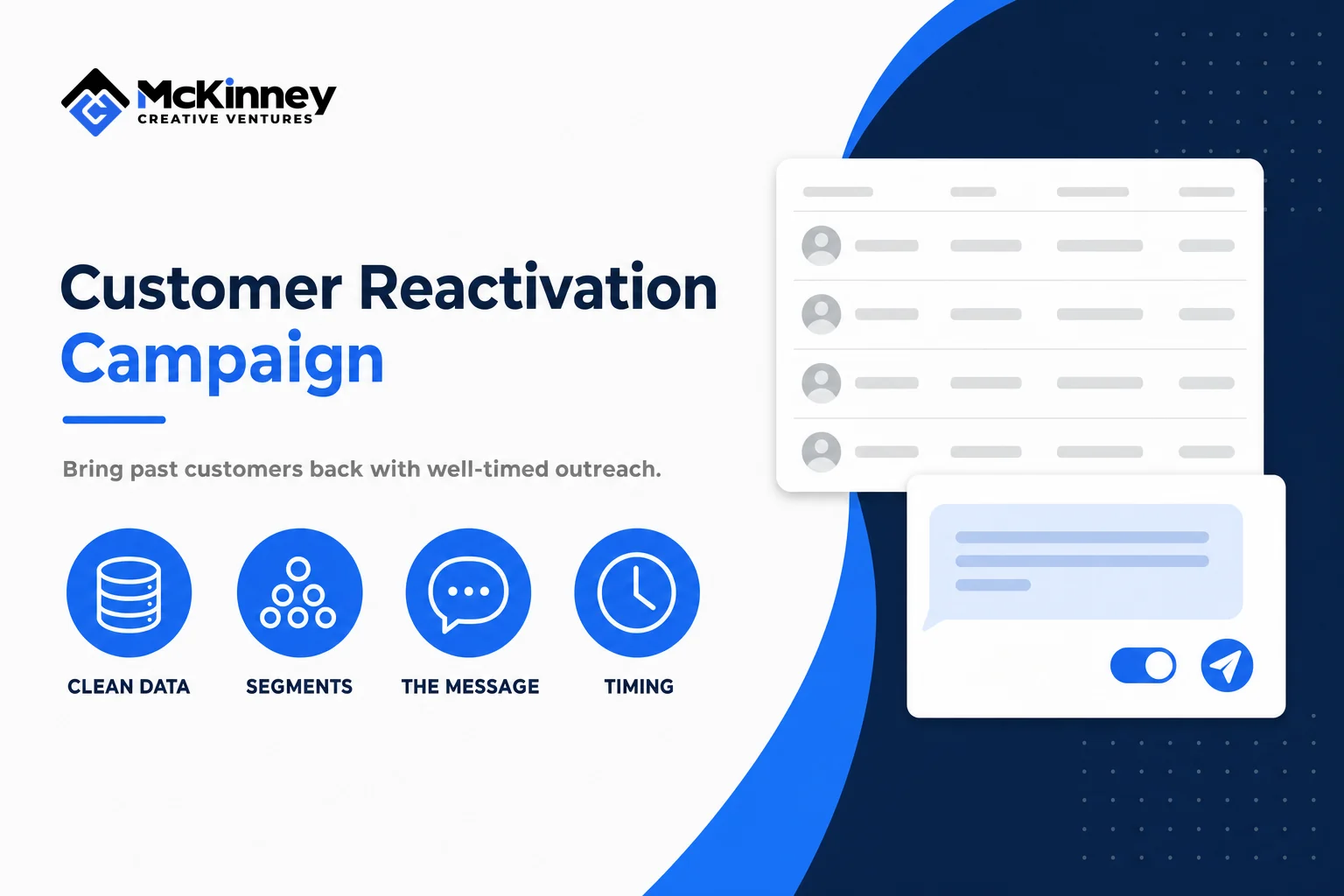
Database reactivation is a focused effort to reconnect with past customers who have a documented reason to come back. It starts with accurate records, a service interval or open recommendation, and one clear next step. It is not a message sent to every old contact.
This guide is for owners of home service businesses in the Twin Cities East Metro, the St. Croix Valley and western Wisconsin. The database may hold completed jobs, seasonal services, unbooked recommendations and old estimates. Those records can support useful outreach, but only when you know what happened, why the message is relevant now and whether the contact is eligible for that channel.
A database reactivation campaign starts with the service interval
The central question is "What should reasonably happen next in this customer relationship?" A furnace tune-up, an irrigation start-up, a water softener service and a one-time remodel run on different timelines, so a single rule such as "contact everyone after six months" ignores the work that was actually done.
A 2023 paper by Niels Holtrop and Jaap E. Wieringa, "Timing customer reactivation initiatives" in the International Journal of Research in Marketing, proposes a method that models each customer's average time between purchases and the variation around it, and flags a customer as inactive when the pattern breaks. The authors tested it in a field experiment with a European greetings and gifts retailer, so it is not evidence about local service companies. The useful idea is broader: a customer is overdue relative to their own pattern, and no single calendar date applies to every record. The paper detects inactivity after it happens. Our practical view is that a service interval lets you contact customers before they lapse.
A small business does not need a prediction model. Define the normal next event for each service category, then build a review list of customers approaching that window.
How long should a home service company wait before running a campaign?
There is no magic number. Wait until the customer's next expected event is close, then contact them ahead of it. The following timing is our view for Minnesota and western Wisconsin service companies, and you should replace it with your own job history.
- Furnace and boiler work: contact customers before the heating season starts, in late summer or early fall, when a tune-up still has time to be scheduled.
- Air conditioning and irrigation: contact customers in early spring, ahead of the first warm stretch and before the start-up calendar fills.
- Water treatment: use the service interval for the equipment installed, which the manufacturer or your own technician notes will state.
- Lawn care and landscaping: reach past customers in winter, before the season books up. Our landscaping marketing guide covers that cycle.
- One-time projects: use a documented milestone, such as a warranty check or a recommended maintenance visit, instead of a date on a calendar.
Clean the customer records before writing the message
Reactivation quality depends on record quality. If the CRM cannot distinguish a customer from a lead, a completed job from a canceled one, or an active service plan from a lapsed one, automation will scale the confusion. Review the systems that already hold history: the CRM, the scheduling platform, the estimating tool, invoices and technician notes. Decide which one is the source of truth for contact details, completed work, consent and suppression.
- Customer identity: one usable record for the person or business, with duplicates resolved.
- Completed service: the category and completion date, recorded without inventing missing detail.
- Next relevant event: a renewal, a maintenance window, a related service or a documented follow-up.
- Channel eligibility: the consent and opt-out state for email, text and calls.
- Outcome: reply, appointment, estimate, completed work, decline or no response.
When a service record is unclear or a contact has opted out, the correct automated action may be no outreach at all.
Build segments from real service events
The useful segment is usually smaller than the marketing list. Group customers by the work they received and the next need the record supports. Keep the first model simple enough to maintain: service category, last completed date, territory, open recommendation and communication status are often enough.
Scroll to see all columns
| Customer group | Natural reason to reach out | What to record |
|---|---|---|
| Heating customers | The heating season is approaching and a tune-up is not booked | Booked visit, later date or not needed |
| Cooling and irrigation customers | Spring start-up or a seasonal check | Booked visit, question or decline |
| Water treatment customers | The equipment's service interval is coming due | Service scheduled, supplies ordered or declined |
| Customers with an open recommendation | A next step is documented in the service record | Estimate, question, decline or completion |
| Contacts with uncertain history | None until the record is resolved | Corrected, merged or suppressed |
Unclosed estimates are a separate follow-up list from past customers. That person never became a customer, so a direct question about whether the project is still planned fits better than a reactivation message. Both lists can run from the same CRM. Use this table to decide who gets a campaign, because not every group should. Confirm the reason still fits, the service is available and the customer is eligible for the channel.
Write one relevant message with one clear next step
A reactivation message should answer three questions fast: who is contacting me, why now, and what can I do next. Reference the service only when the record supports it. "We serviced your furnace last fall" is useful if that date is accurate. "It is time to replace your system" is not, when no one has assessed the equipment.
Pick one next step: a reply, an estimate request or an appointment window. If you cannot respond promptly or the schedule is full, delay the campaign or narrow the segment. Replies also arrive when nobody is watching the phone, so connect the campaign to a missed call text back setup. An offer is optional. If you use a discount, document its terms and make sure the team can honor it.
Database reactivation service or your own CRM?
A done-for-you database reactivation service and a campaign you run inside your own CRM do the same job. The difference is who does the work. Either way, the customer list should stay yours; ask any provider in writing who owns it and how you get it back.
A done-for-you service should include, at a minimum:
- A review of your records, with duplicates and bad contacts flagged before anything is sent.
- Segments built from your service history, not from a purchased list.
- Consent and suppression handling, with opt-outs written back to your main record.
- Message drafts that you approve, and a named person who handles replies.
- A booking handoff, so a yes becomes an appointment in your calendar.
- Reporting by booked and completed work as well as delivery and clicks.
Doing it yourself costs time instead of a fee and works well when your CRM already holds clean service history. We build CRM and automation systems on GoHighLevel, so we have a stake in that answer, and a good reactivation process also works in other CRMs. Our guide to CRM systems for local service businesses explains what to look for, and our CRM and automation service describes how we set it up.
Treat consent and opt-outs as operating data
The following is general information, not legal advice. Federal rules differ by channel, state rules may add duties, and your attorney should confirm what applies to your messages and your records.
The FTC's CAN-SPAM compliance guide says the law covers all commercial messages and makes no exception for business-to-business email, and its example of a covered message is one "to former customers announcing a new product line." It lists the main requirements: accurate header information, no deceptive subject lines, a clear disclosure that the message is an ad, a valid physical postal address, and a clear way to opt out. It says you must honor an opt-out request within 10 business days. The guide also says the law views "transactional or relationship" messages narrowly, so you should not assume that any message to someone you already do business with falls in that category.
Texts and calls
The FCC's consumer guide on robocalls and texts says FCC rules ban text messages sent to a mobile phone using an autodialer unless the phone owner previously gave consent, and that commercial texts require written consent. The guide does not address past customers specifically. Ask your attorney whether your texting tools and your consent records meet those rules. The guide also says a consumer may opt out of any robocall or robotext at any time and in any reasonable manner, even after giving consent, and that many states keep their own do-not-call lists.
Operationally, the cleanest workflow is immediate suppression. Record the opt-out on the main contact, stop the active sequence and make the status visible to every future campaign. A suppression flag buried in one automation is not enough if another list can ignore it next month.
Run a small campaign and measure business outcomes
Start with one service segment and one message. A small launch exposes wrong numbers, duplicate contacts, broken links and handoff problems before they reach the full database.
- Record the audience. Save the inclusion rules and the count of eligible contacts without exporting more customer data than you need.
- Test the workflow. Check sender identity, links, replies, appointment routing, opt-out handling and who owns each response.
- Launch a controlled batch. Watch for incorrect records, complaints and unexpected replies before expanding.
- Reconcile the outcome. Connect the campaign to inquiries, appointments, estimates, completed work, declines and opt-outs where the records genuinely link.
Delivery, opens, clicks and replies are signals and do not count as booked revenue. A reply may be a request to stop, and a click may never become an inquiry. Report each stage separately and count completed work only when the records connect.
If your customer history is scattered across tools, or follow-up happens only when someone remembers, contact us and we will map the records, triggers and handoffs a practical reactivation process needs.