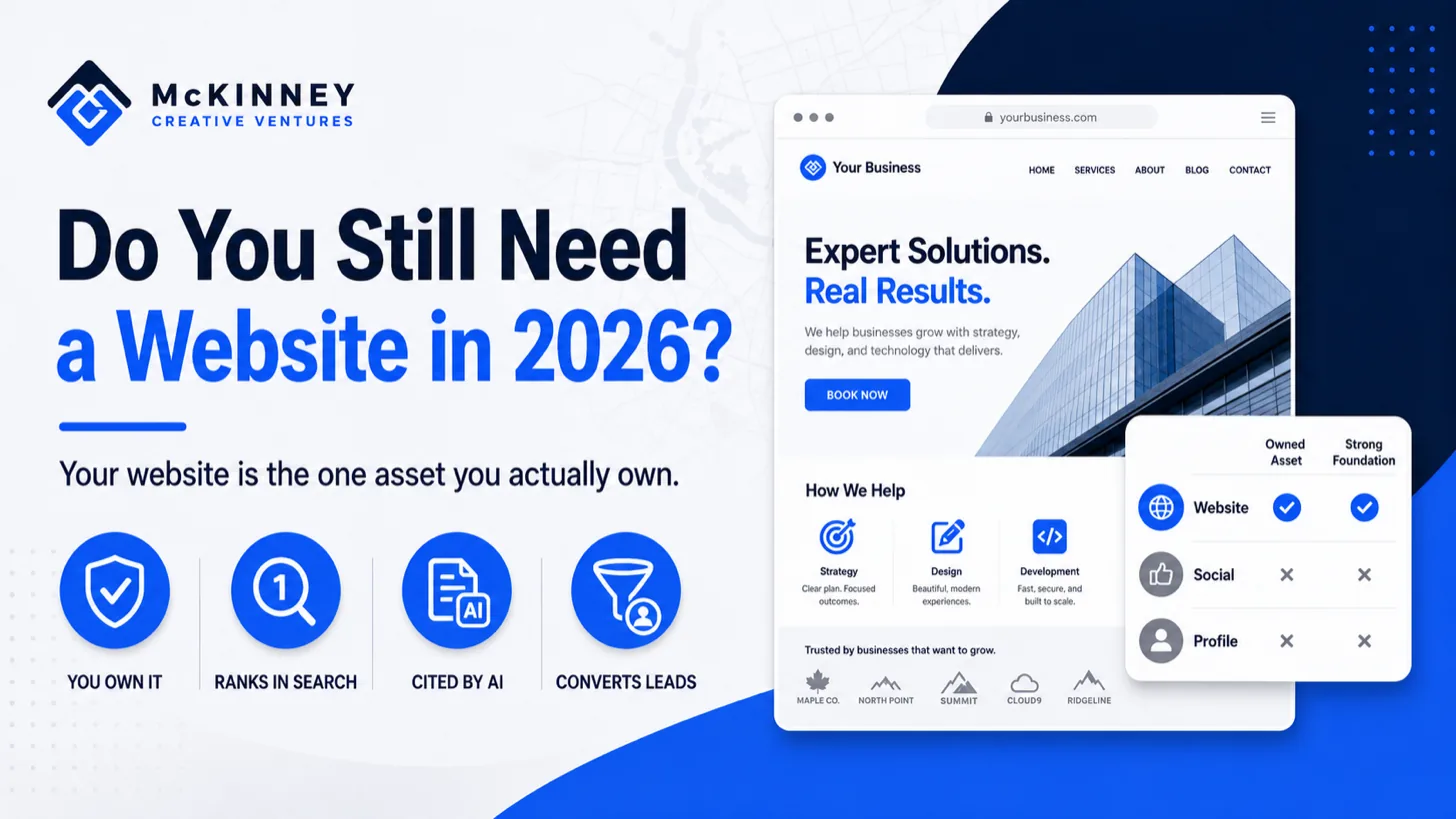
Do I need a website in 2026? For most local service businesses in the Twin Cities East Metro, the St. Croix Valley and western Wisconsin, yes. A Google Business Profile does a lot of the finding, and it is worth doing well. A website you own holds the proof, the contact paths and the measurement that a profile has no room for.
This post is for owners of plumbing, HVAC, electrical, roofing, cleaning and similar companies who wonder whether a free profile and a good set of reviews are enough. We take the case for skipping a site seriously, say where it holds up, and then list what only a website does. What a good site contains is a separate subject, covered in our modern website design guide.
Do I need a website in 2026? The case for skipping one
Three arguments come up most often. A profile is free, and it is often the first thing a searcher in Woodbury or Stillwater sees. Some owners expect AI answers to summarize businesses without sending a click. A social page gives you somewhere to post and take messages.
The first argument has real support. Google's Business Profile guidelines ask for a phone number that connects to your location or a website that represents it. In our reading, that means Google does not require a website to have a profile. A business can be listed, rated and called without one.
In our view, a business can get by without a site in one narrow case. It works only on referrals and repeat customers, it never needs a stranger to find it, and a phone call is the only contact path it wants. Even then, it has no place to show proof beyond a profile and no data of its own about who is looking. Once the company wants work from people who have not heard of it, the answer changes.
What a Google Business Profile does well and where it stops
A profile puts your hours, photos, reviews and a call button in front of people searching Google and Maps. Google's page on local ranking says local results are mainly based on relevance, distance and popularity, and that there is no way to request or pay for a better local ranking. You can complete every field, but you cannot buy placement or choose the layout.
The same page gives two examples of the information popularity draws on: how many websites link to your business and how many reviews you have. Reviews live on the profile. Links come from other sites, and in our experience what they point to is usually a business's website.
A profile is also a single listing on someone else's platform. Google's suspension appeals page says an account may be restricted when a policy is violated, which suspends the profiles it manages, and that an appeal can only be submitted once. We are not predicting that your profile will be suspended. The point is that a business with only a profile has no second place for customers to find it.
What AI search features need from a page
Google's guide to AI features and your website says a page must be indexed and eligible to be shown in Google Search with a snippet to be a supporting link in AI Overviews or AI Mode, and that there are no additional technical requirements. It says the usual SEO fundamentals still apply, including keeping Business Profile information up to date, and that indexing and serving are never guaranteed.
In our reading, that requirement describes web pages. A business with no site has no page of its own to be indexed. In our reading, the web-page side of those features then depends on pages other people publish about it, plus the Business Profile information Google's page says to keep up to date. We do not promise that a website earns an AI mention, and Google does not either. The narrower point is that without a page there is nothing to be eligible.
What customers do after they read your reviews
BrightLocal's Local Consumer Review Survey 2026 (1,002 US adults, published February 2026) found that 41% always read reviews when browsing for businesses, up from 29% the year before. It also asked what people were likely to do next after reading positive reviews, and respondents could choose more than one action. Visiting the business's website was the most common answer at 54%, up from 32% when BrightLocal asked in 2019. It is a national survey and does not measure East Metro homeowners, so read it as direction.
Here is an illustrative example. Marrowby Drain Service is an invented company with strong reviews. A homeowner in Stillwater reads them, taps the website link, and looks for three things: whether the company serves Stillwater, whether a phone number is easy to find, and whether the license number the company advertises is shown. If the site is missing, thin or hard to use on a phone, the good reviews have brought the homeowner to a dead end.
What only your website does
It holds the proof and the detail
A profile has fields. A website has room for a page on each service, the places you work, how a job runs, who comes to the door and examples of finished work. That detail is what a homeowner reads when deciding between two companies with similar reviews, and it is the text search engines have to work with.
It gives you the contact path
On your own pages you decide how a visitor reaches you: a short request form that lands in your CRM, a booking request, a tap-to-call number, a text option. Our website design service covers design, rebuilds, hosting, ongoing management, and custom web apps, and the forms and booking tools are wired to the system behind them. A profile gives you the buttons Google offers.
It lets you measure your own results
In our reading, a profile's reporting is limited to the figures Google's tools provide. A website lets you install analytics and count the pages and actions you define, such as form submissions and phone taps. Our Google Analytics setup guide walks through the steps.
It carries the rules that apply to your trade
If you hold a Minnesota residential building contractor, residential remodeler, manufactured home installer or residential roofer license, Minn. Stat. 326B.87 says the license number must appear in any advertising by that licensee, and the list in the statute includes websites and Internet ads. The Department of Labor and Industry's residential contractor FAQ adds that the law does not require a specific print size or location for the number. The statute's definition of licensee covers those residential license types, so plumbers, electricians and mechanical contractors should check the rules for their own licenses.
Wisconsin is separate. The Wisconsin DSPS dwelling contractor page describes a credential for a contracting business seeking certification to obtain building permits for one- and two-family dwellings. We did not find a website advertising rule on that page, so a Hudson or River Falls contractor should ask DSPS and an attorney what applies. This is general information. It is not legal advice.
Scroll to see all columns
| Question | Your website | Google Business Profile | Social page |
|---|---|---|---|
| Who sets the layout and rules? | You | The platform | |
| Where does full service detail and proof go? | On pages you write | In the fields and posts Google offers | In posts the platform formats |
| Who decides how a visitor contacts you? | You, through forms, booking and call buttons | Google's profile buttons and the details you enter | The platform's messaging tools |
| Where does it live? | On your own domain | In Google Search and Maps | On the platform's site |
What the website has to do once you have one
A site that cannot be found, is hard to use on a phone or hides the phone number leaves the job to the next company in the results. A short list covers most of it: a first screen that says what you do and where, service pages for each thing you sell, proof a stranger can check, and one obvious way to contact you. The modern website design guide linked above covers each of those in detail.
If you want a second opinion on whether your current setup is doing that work, you can contact us and we will go through it with you.