

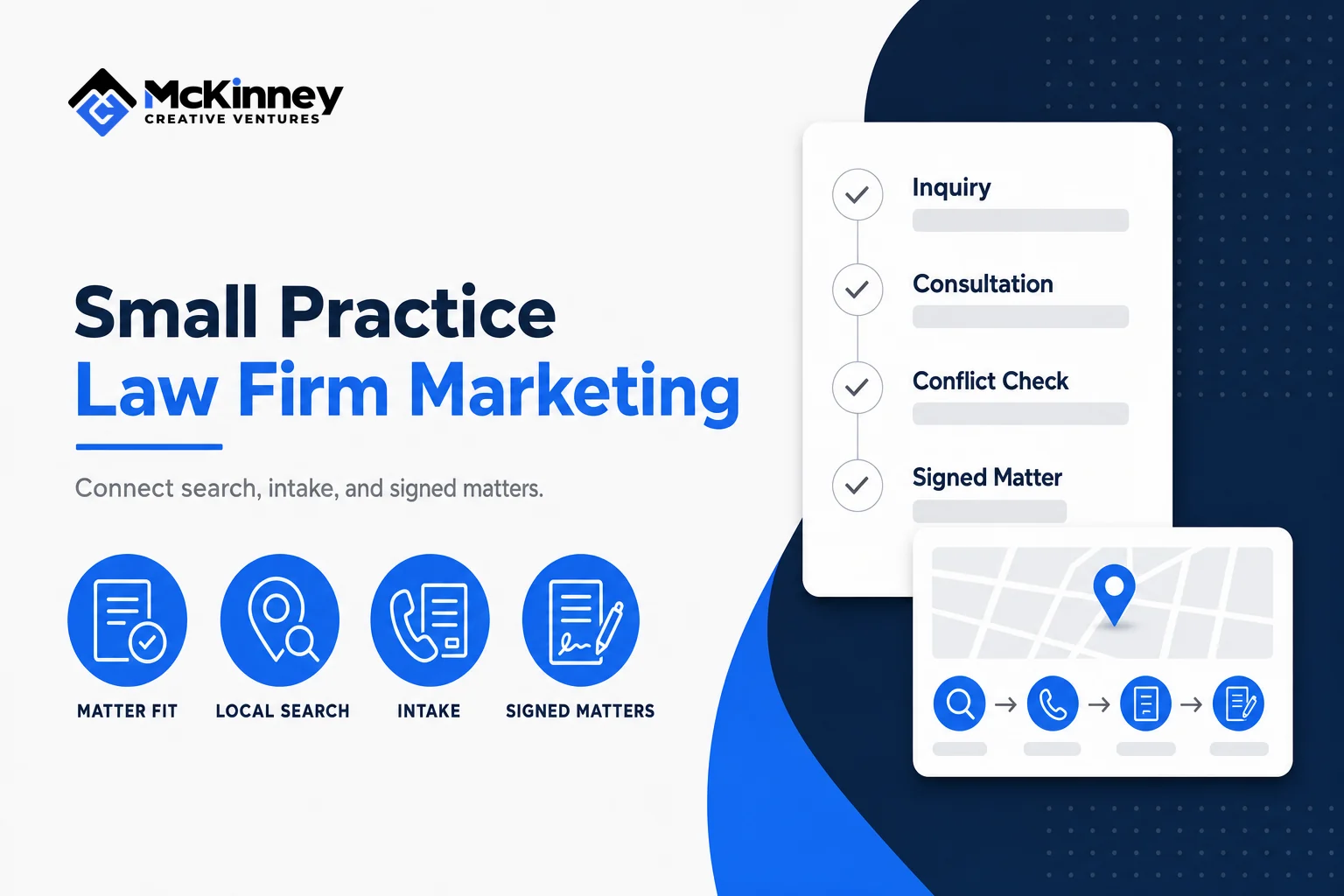
Law firm marketing for a small practice should do four jobs: help the right people find the firm, show why the firm fits their matter, make the first contact easy, and carry qualified inquiries through consultation and engagement. The system is only useful when the firm can trace each signed matter back to a source and learn where prospective clients stop.
This guide is for solo lawyers and small firms serving the Twin Cities East Metro, St. Croix Valley, and western Wisconsin. It is a marketing framework, not legal advice. Lawyer advertising, solicitation, confidentiality, conflicts, testimonials, fee statements, and lead providers are governed by professional rules that vary by jurisdiction. The responsible lawyer should review every campaign and intake process against the rules that apply to the firm.
Scroll to see all columns
| Prospective client question | Firm asset | Intake evidence | Decision metric |
|---|---|---|---|
| Do you handle my kind of matter? | Focused practice page with scope and limits | Page and search query that produced the inquiry | Qualified inquiries by practice area |
| Do you serve my location? | Accurate office and service-area information | Caller location and applicable jurisdiction | In-area qualified inquiries |
| Can I trust this firm? | Lawyer credentials, process, real reviews, and useful guidance | Questions raised before consultation | Consultations scheduled and completed |
| What happens next? | Clear contact path and response expectation | Time to first response and consultation status | Qualified consultations that become signed matters |
| Which marketing is worth keeping? | Source tracking connected to intake | Original source, matter type, disposition, and revenue | Signed matters and collected revenue by source |
Law firm marketing starts with matter fit
A small firm cannot outspend every broad competitor, and it should not try. Start with the matters the firm is equipped and willing to take. Define the practice area, geography, client type, minimum case fit, conflicts that commonly disqualify an inquiry, and the capacity available for new matters. Marketing should make those boundaries clearer before someone calls.
Choose a narrow promise the firm can support
A page titled "Family law attorney in Woodbury" should explain the family-law matters the firm accepts, where the attorney is licensed, how the first conversation works, and what the firm does not handle. A generic page that lists every possible legal issue creates more inquiries, but it also creates more screening work and more disappointment.
Claims need their own review. Minnesota Rule of Professional Conduct 7.1 says a communication about a lawyer or the lawyer's services cannot be false or misleading. Its comments explain that a truthful statement can still mislead when it creates a conclusion with no reasonable factual foundation, and that unsubstantiated claims or comparisons may be misleading. Read the current Minnesota Rule 7.1 and comments before publishing results, comparisons, fee claims, or language such as "best" and "top." A disclaimer can add context, but it does not turn an unsupported claim into a sound one.
Build one source-of-truth brief
Before writing pages or ads, create a short approved brief for each practice area. Record the attorney responsible for the content, jurisdictions, office locations, accepted matter types, real credentials, fee language the firm approves, common disqualifiers, and the next step. The website, Business Profile, directories, ads, and intake script should draw from that same brief. When a fact changes, update the source first and then the channels.
Build search visibility around how clients describe the problem
People often search by problem, location, or deadline before they know the formal name of a legal service. A useful content plan connects those questions to a clear practice page. The goal is not to publish a definition of every legal term. It is to explain which situations the firm handles, what information helps at the first contact, and when the reader should seek advice specific to the facts.
Keep local information accurate
For a Woodbury or Stillwater firm, the Business Profile should show the real office, current hours, correct category, phone number, and website. A firm serving clients across the St. Croix River should not imply an office in Hudson or River Falls if it has none. Google says local results are mainly based on relevance, distance, and popularity, and that complete, detailed business information helps it understand relevance. Its local ranking guidance also says there is no way to request or pay for a better local ranking.
Local visibility therefore needs accurate facts, useful practice pages, consistent listings, and earned reputation. It is not a guaranteed placement. Our SEO, GEO, and AEO work focuses on those foundations and on measuring what search actually produces.
Make the website answer the hiring questions
The firm's site should give a prospective client enough information to decide whether contact makes sense. For each practice area, cover who the service is for, common situations, the consultation process, the attorney responsible, the geography served, and a plain next step. Add real credentials and links to the applicable licensing profile where useful. Do not publish a result or testimonial without confirming that the wording, context, permission, and professional rules support it.
The American Bar Association's 2024 Solo and Small Firm TechReport says 70 percent of solo firms reported having a website, 23 percent allowed online scheduling, and 76 percent of solo attorneys personally managed and created website content. Those figures describe the survey respondents, not every law firm. They do show why a small firm's site has to be maintainable: if an attorney owns the updates, the publishing process must be simple enough to use without taking over the practice.
Connect every inquiry to an intake decision
More leads are not the same as more suitable clients. An intake system should tell the firm whether an inquiry fits the practice, whether a conflict check is needed, whether a consultation was scheduled, and what happened afterward. Marketing source belongs in that record, but it is only one field.
Design a short first-contact path
Use a contact form that asks only for the information the firm has approved for the first contact. Explain that submitting the form does not create an attorney-client relationship. Route urgent and unsuitable matters according to the firm's written process, and keep sensitive narrative out of general marketing systems unless the responsible lawyer has approved the data handling.
Then set ownership. One person or role should receive the inquiry, confirm receipt, request the next approved information, and record the status. Automation can acknowledge a form or missed call, but it should not give legal advice, promise representation, or announce that a conflict has cleared. Our CRM and automation service can organize response, routing, appointment status, and source tracking around the firm's approved process.
Measure the whole path, not the first conversion
Track source, qualified or unqualified status, consultation scheduled, consultation completed, engagement decision, signed matter, and revenue where appropriate. The ABA's September 2026 article Why More Leads Don't Always Mean More Clients recommends connecting marketing, intake, and financial reporting so a firm can evaluate signed clients and revenue instead of lead volume alone.
This changes budget decisions. A directory may produce many inquiries but few qualified consultations. A referral source may produce less volume and more signed matters. Paid search may work for one practice area and fail for another because the economics, competition, or intake process differ. The answer comes from dispositions, not from the channel's dashboard.
Use reviews, referrals, and content as verified proof
Law is a high-trust purchase. Prospective clients want to understand the attorney, the process, and whether the firm appears prepared for their kind of matter. Proof should be specific and supportable, not theatrical.
Ask for honest reviews through an approved process
Create one review-request process and have the responsible lawyer approve the request, timing, platform, consent handling, and response rules. Ask consistently instead of selecting only the people expected to post praise. Never write a review for a client or reward a particular sentiment. Public replies should be restrained and should not confirm representation, reveal facts, or argue about a matter.
Publish guidance that earns the next question
Good law firm content answers a narrow question, states the limits of the answer, and gives the reader a useful next step. A Minnesota estate-planning firm might explain what documents to gather before an initial conversation. A Wisconsin business lawyer might explain the questions an owner should bring to a contract review. The article should cite the controlling public source where appropriate and avoid applying a general rule to a reader's unknown facts.
Content also creates material for referral partners. A short, accurate guide is easier to share than a generic firm brochure. Keep the article current, show the real author, and record when the legal source was checked.
Buy advertising and leads only after the rules and intake are ready
Paid search can put a focused practice page in front of people who are actively looking, but paying for traffic before intake is measurable compounds the leak. Confirm the landing page, call routing, form delivery, response owner, matter-fit fields, and source tracking before increasing spend. Our digital advertising service measures campaigns against business outcomes rather than treating a click as the finish line.
Minnesota Rule 7.2 permits communications about a lawyer's services through any media and allows reasonable advertising costs. It also addresses lead generators, referrals, specialist language, and the lawyer or firm responsible for the communication. Read the complete Minnesota Rule 7.2 and comments before signing with a lead provider or approving an ad. Do not assume the vendor's template makes the firm compliant.
Western Wisconsin firms need a separate rule review. Wisconsin SCR 20:7.1 and 20:7.2 address false or misleading communications, comparisons, testimonials, advertising, and lead generation. The current Wisconsin Rules of Professional Conduct, Chapter 20B should be checked against the exact campaign. A firm advertising on both sides of the St. Croix should not merge the two states' rules into one summary.
Run the system in a practical order
First, define matter fit and approve the source-of-truth brief. Second, fix the practice pages and local business information. Third, test intake from every contact path without creating a false inquiry or exposing client information. Fourth, connect sources to consultation and engagement status. Fifth, build a consistent review and content process. Paid campaigns come after those pieces can be measured.
Review the system monthly. Ask which pages and sources produced qualified inquiries, where consultations were lost, which matters were signed, and whether any public claim or rule source needs an update. Keep what produces suitable work, repair the handoff where people disappear, and stop paying for volume the firm does not want.
If your firm needs a connected website, search, advertising, and intake plan built around its real practice and approval rules, book a strategy call with McKinney Creative Ventures.