

Outsourced marketing support means paying an outside person or team to plan, build and run part of your marketing while you keep the decisions only you can make. This post is for owners of small local service businesses in the Twin Cities East Metro, the St. Croix Valley and western Wisconsin who are stretched thin and trying to decide what to hand off and what to hold on to.
The short answer is that execution and specialist skills are good to outsource, and voice, approvals, customer knowledge and the final say on offers are not. The rest of this post sorts the options, shows what an in-house marketing hire costs in Minnesota using government wage data, and describes how to stay in control and judge results without relying on anyone's promised numbers.
What Outsourced Marketing Support Covers
Outsourced marketing for small business is a range, not one service, and outsourced marketing services are sold at every point on it. At the light end it is a freelancer writing blog posts or managing your Google Business Profile. At the heavy end it is an agency or consultant that sets strategy, builds the website, runs search and ads, manages the CRM and reports on results.
For a local service business, the work that most often gets handed off falls into five groups:
- Website and content. Building and updating pages, writing posts and keeping service-area pages accurate.
- Search and local visibility. On-page work, Google Business Profile management and citations. Our SEO and local search service is in this group.
- Paid advertising. Google Search and Local Services Ads setup, budgets and reporting.
- CRM and automation. Lead capture, follow-up, booking and review requests.
- Reporting. Pulling the numbers together so decisions are based on booked jobs, not clicks.
The scope should be written down before work starts. In our experience, a common source of disappointment is a scope that was assumed, not agreed.
What to Keep In-House
Four things should stay with you, because an outside team cannot do them as well and the risk of getting them wrong falls on your business.
- Voice. How your company sounds when it talks to customers. A vendor can draft in your voice, but you decide whether it sounds like you.
- Approvals. Anything published under your name, including claims, prices, guarantees, licenses and photos of your work. Require your sign-off before it goes live.
- Customer knowledge. You know which jobs are profitable, which customers are a poor fit and what questions you hear every week. Share it with the vendor regularly.
- Final say on offers. Discounts, financing, service areas, response promises and capacity. These commit your crews and your margins.
This is the core answer to a common question: how do you outsource the time-consuming parts of marketing while staying in control of voice and strategy? You hand off production and keep approval. Insist on access to every account, including your ad accounts, analytics, domain and CRM, in your own name, so that control is real and you can leave without losing your assets.
Comparing In-House Hires, Freelancers, Agencies and Fractional CMOs
The right option depends on how much strategy you need, how much work there is to do, and how much management time you have. This table compares the four common models by what they are good at, not by price, because prices vary too widely to give a fair number.
Scroll to see all columns
| Option | Best at | What you manage | Main limit |
|---|---|---|---|
| In-house hire | Daily presence, deep knowledge of your business and fast internal coordination | Hiring, training, tools and performance | One person rarely has every skill, and a vacancy stops the work |
| Freelancer | A defined task such as copy, design or a profile cleanup | Briefing, review and coordination between several freelancers | Limited strategy, and capacity depends on one person |
| Agency | Strategy and execution across several channels under one contract | Scope, approvals and reporting review | Quality and attention vary, and a poor fit is costly to unwind |
| Fractional CMO | Senior planning, priorities and oversight of other vendors | Access, decisions and the hands-on team they direct | Plans still need someone to carry them out |
The last row answers another common question, whether one service can provide both strategic leadership and hands-on implementation. Some agencies do both under one contract, and a fractional CMO can pair with an implementer. Whichever you choose, ask who does the work and who is accountable for the plan. Our post on fractional CMO versus in-house marketing goes deeper on that choice, and we cover how to evaluate agencies in choosing a marketing agency.
What an In-House Marketing Hire Costs in Minnesota
The Bureau of Labor Statistics publishes wage estimates for Minnesota through its Occupational Employment and Wage Statistics program. In the OEWS query system for Minnesota, all industries, reference period May 2025, the annual median wage for Market Research Analysts and Marketing Specialists was $87,510. For Marketing Managers it was $173,300.
Read those figures carefully. They are median pay for people employed in those occupations across the state, in all industries. They do not include the other costs of an employee, they do not describe what a local service business would need to pay for one, and a smaller business may hire at a different level. They do give a plain reference point. A single marketing specialist is a major payroll commitment before any software, ad spend or management time, and one person still covers only part of the skills in the list above.
That is the Minnesota case for outsourcing: you can buy several skills for a defined scope without hiring for each. It is not automatically cheaper. We could not find a reliable source for a general percentage saving from outsourcing, and we would distrust anyone who quotes one, so decide on your own numbers: what you would pay for the scope, compared with the hire plus the tools.
How to Stay in Control of Voice and Strategy
Control comes from process more than from trust. Five habits keep it.
- Write a one-page brief. Who you serve, which jobs you want more of, where you work, what you will not do and how you talk.
- Own the accounts. Website hosting, domain, Google Business Profile, ad accounts, analytics and CRM should be in your name with the vendor added as a user.
- Approve before publishing. Set a short review window for every public piece, and require the vendor to flag anything that makes a claim.
- Hold a monthly review. Look at leads, booked jobs by source and what changed. Ask for the reasoning behind each change.
- Keep the strategy document. If the vendor holds the plan only in their heads, you are dependent on them. Ask for it in writing.
Google's own guidance on hiring an SEO makes the same point from the other side. Its Search Central page suggests asking providers for examples of previous work, how they measure success and whether they will share every change they make and explain their reasoning. It also says you are responsible for the actions of any company you hire.
Can Outsourced Marketing Support Improve Local Visibility?
It can, because local visibility is a set of tasks that a skilled outside team can do consistently. Google's help page says local results are mainly based on relevance, distance, and popularity, and that businesses with complete and accurate information are more likely to show up in local search results. A vendor cannot change your distance from the searcher. It can keep your profile accurate, build pages that match what people search for and help you earn more reviews.
What a vendor cannot do is guarantee a position. Google's Search Central page says no one can guarantee a number one ranking on Google, and that if someone guarantees first place, you should find someone else. For East Metro and Twin Cities service businesses, the realistic promise is steady work on the factors you can control, tracked against a baseline.
Check for local depth. In our experience, a vendor who knows how homeowners in Woodbury, Stillwater or Hudson search, and how service areas cross the Minnesota and Wisconsin line, makes fewer generic choices. Ask for local examples. See our Twin Cities service area page for the market we serve.
How to Judge the ROI of Outsourced Marketing Without Invented Numbers
People often ask what ROI others have actually seen from outsourcing. We have no honest average to give you. Published ROI figures often come from vendors, can mix different industries and do not always show how they were measured. Treat them with caution.
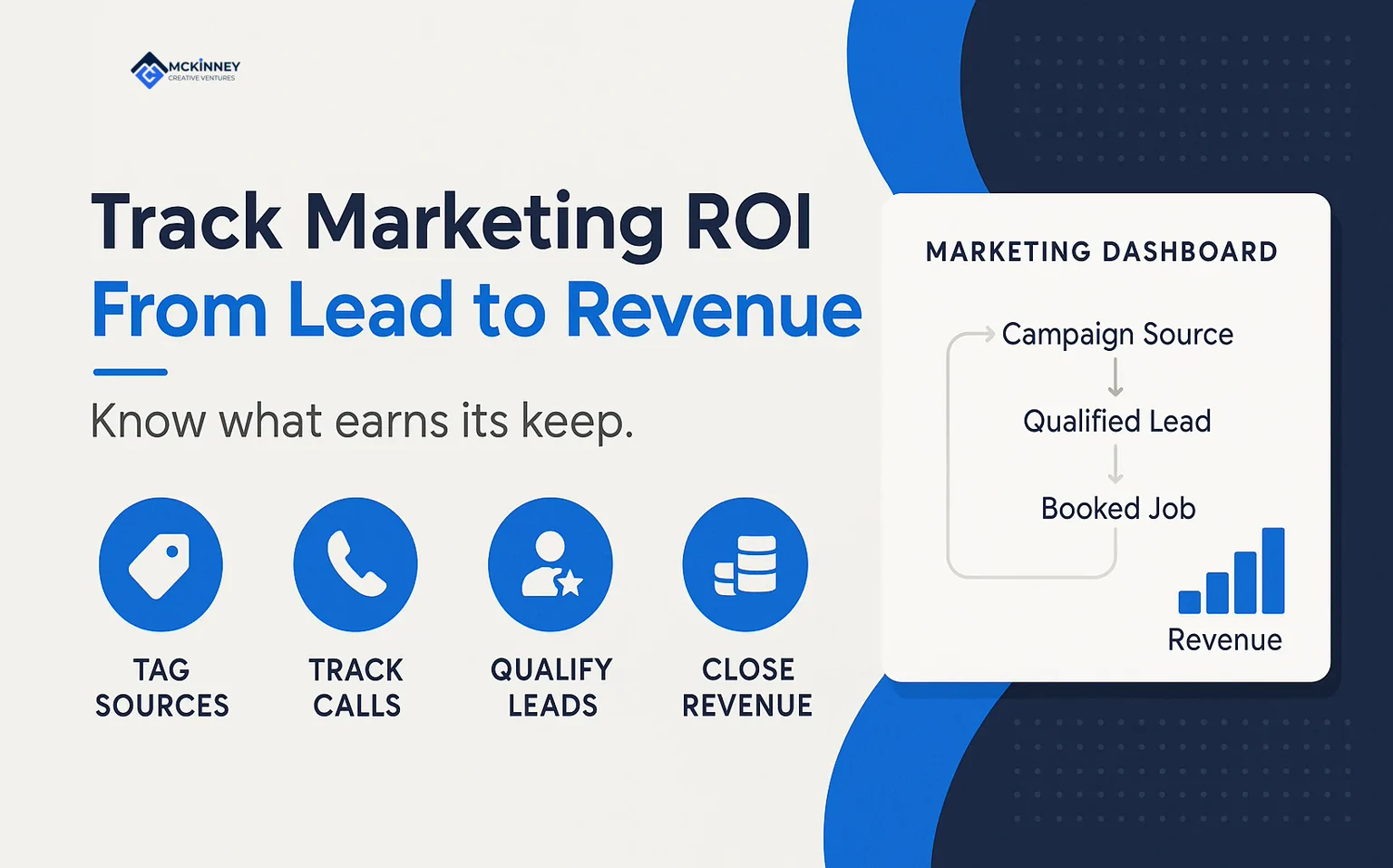
Use your own baseline instead. Before the work starts, record for the previous 90 days: calls, form leads, booked jobs, revenue by source and what you spent on marketing. Then check the same figures monthly after the work begins. The comparison that counts is booked jobs and revenue, not traffic, impressions or rankings.
Give search work time to show up, and give ad work a few weeks of data before changing it. Ask the vendor to name, in advance, which three numbers will show the work is on track. If they cannot, that is information about the vendor.
If you want to talk through which parts of your marketing to hand off first, contact McKinney Creative Ventures and we will help you scope it.