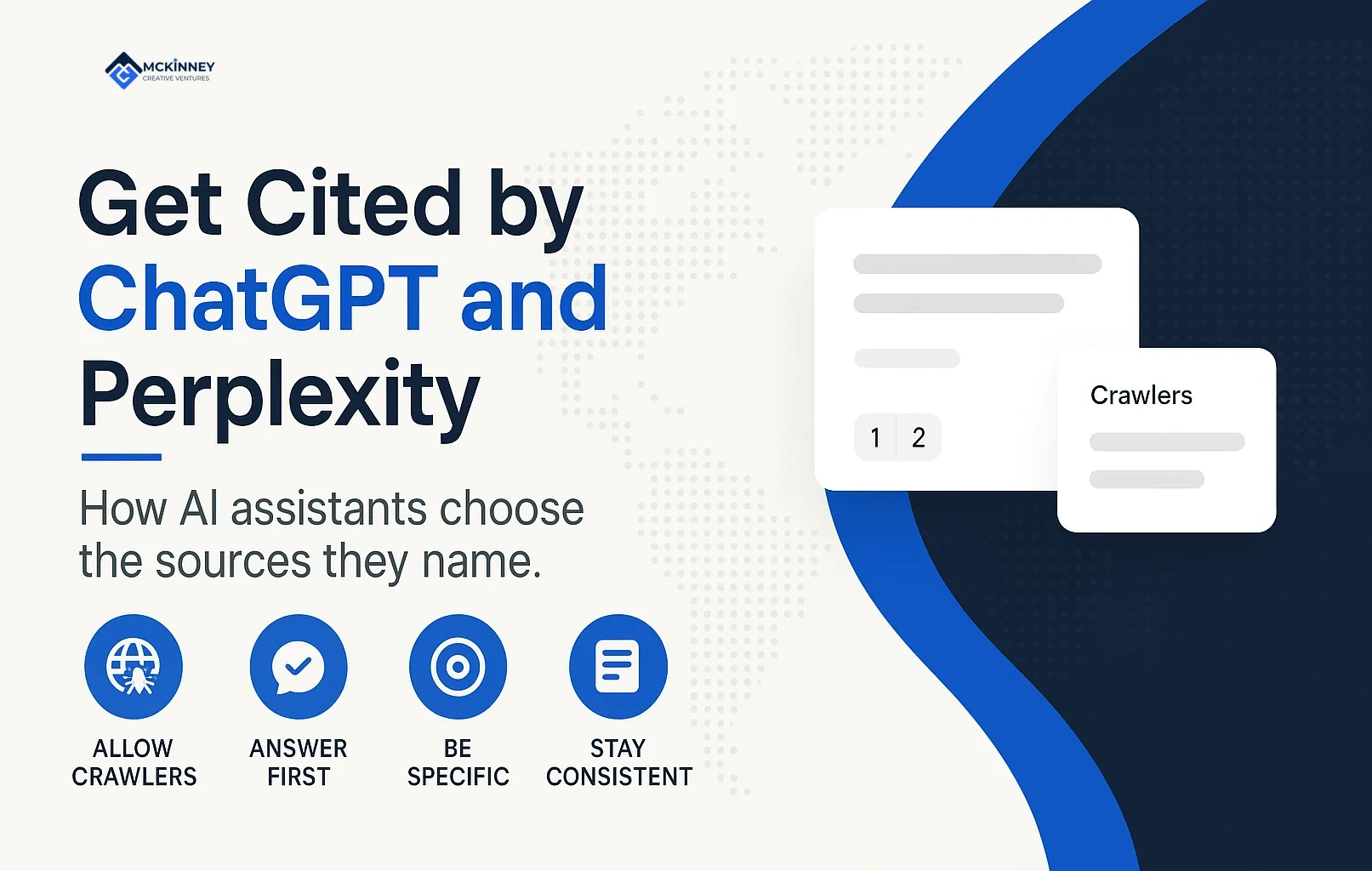


AI SEO is the work of keeping a business findable when Google, ChatGPT and similar tools answer a question before they list a single link. If your search traffic has slipped, this post is for owners in the Twin Cities East Metro, the St. Croix Valley and western Wisconsin who want to know whether AI answers are the cause, what the research says, and how to check their own numbers before spending money.
We separate what the studies measured from what they did not, show how to read the shift in Search Console and Analytics, and keep the step-by-step setup work in our Twin Cities SEO, GEO and AEO guide. This post is about the traffic, and that guide is about the build.
What AI SEO means for a Twin Cities business
Google's own page on AI features and your website describes two of them. AI Overviews help people get to the gist of a topic and give them links to learn more. Google calls AI Mode particularly helpful for queries where further exploration, reasoning or complex comparisons are needed, with links to supporting websites. Google says an AI Overview appears only when its systems judge that it adds something to classic Search, so it often does not trigger. The page, last updated December 10, 2025 according to its footer, also says there are no additional requirements to appear in either feature and no special optimization to do.
People can also put the same questions to ChatGPT, Perplexity, Gemini and Claude. OpenAI's crawler documentation lists separate robots.txt settings for each job. OAI-SearchBot is for ChatGPT's search features, and GPTBot is for crawling content that may train its models. The page says the settings are independent, so a site can allow one and disallow the other.
GEO (generative engine optimization) and AEO (answer engine optimization) are the industry's names for work aimed at those answers. In practice, AI SEO for a local business comes down to the same foundations Google already lists, plus a way to tell whether the shift is hitting your own pages. We cover the foundations below and link the full build guides.
What the research says about clicks
Four studies look at the shift. They measured different things, so the table sets them side by side with each one's sample and its limits. Do not add the figures together or read one as a check on another.
Scroll to see all columns
| Study | Sample and period | What it reports | Limit to keep in mind |
|---|---|---|---|
| Ahrefs, published February 4, 2026 | 300,000 keywords from Ahrefs' database, 150,000 with an AI Overview and 150,000 informational keywords without one; Search Console desktop click-through rate, December 2023 against December 2025 | An AI Overview correlates with a 58% lower click-through rate for the top-ranking page | A correlation estimate from a keyword database, built on informational keywords |
| Pew Research Center, July 22, 2025 | Browsing data from 900 U.S. adults, March 1 to 31, 2025 | A traditional result link was clicked in 8% of visits with an AI summary and 15% of visits without one | One month, all kinds of Google searches, no local breakdown |
| Agarwal and Sen, summarized by the Indian School of Business | A field experiment with more than 1,000 U.S. participants, two weeks, using a browser extension | Organic clicks fell by about 39.8% where AI Overviews appeared, with about the same reported satisfaction | The page does not give a publication date |
| Seer Interactive, April 2026 | 53 brands and 5.47 million tracked queries, January 2025 to February 2026 | Organic click-through rate on AI Overview queries was 1.3% in December 2025 and 2.4% in February 2026 | Seer calls its data directional, and the figures cover its tracked brands |
Ahrefs compared its keyword sets two years apart. Its earlier version, published April 17, 2025 and covering March 2024 to March 2025, put the gap at 34.5%, and the February 2026 update puts it at 58%. The update also reports the effect shrinking down the page, to about 19.4% lower at position ten.
Pew found that people who saw an AI summary rarely clicked a link inside it, in just 1% of visits to such pages. It also found that 18% of the Google searches in its study produced a summary.
Seer's number runs the other way. Its organic click-through rate on AI Overview queries recovered from the December 2025 low, but the report puts the January 2025 figure at 3.2%, so the rate is still well under where it started, and Seer cautions that two months of data is a short run. Google says on its AI features page that clicks from results pages with AI Overviews are higher quality, meaning users are more likely to spend more time on the site. That is Google's statement. The Agarwal and Sen summary reports that visits after an AI summary looked similar to other visits in time on site and bounce rate.
What the studies do not tell you about local service searches
None of the four studies isolated searches for a plumber in Woodbury or a roofer near Stillwater. Seer's tracked queries include some with "near me" in them, and we found no figure in any of the four reports for local service businesses specifically. That gap matters, because the intent of a search changes how often an AI Overview appears. Seer's data puts AI Overviews on roughly 1 in 3 informational queries and on just under 1 in 20 transactional queries. The same report found AI Overviews on 76.9% of the informational queries that contain "near me", and says that may differ greatly by industry. Pew found AI summaries on 8% of one- and two-word searches and on 53% of searches of ten words or more.
In our reading, those pieces fit together this way. A short, urgent search like "furnace repair Woodbury" sits closer to the transactional end, where the map results and ads are the main answer. A long question like "how much does it cost to replace a furnace in Minnesota" sits at the informational end, where an AI summary is more likely. If that is right, the traffic most exposed on a service business site is the cost guide, the how-to post and the comparison page, and the service and location pages are less exposed. Seer's 76.9% figure for informational "near me" queries points the other way for that one group, so we would not treat any local page as safe. That is our inference from other people's data, and your own Search Console will confirm or contradict it for your site.
How to see the shift in your own Search Console and Analytics
Google's AI features page says sites appearing in AI Overviews and AI Mode are included in overall Search Console traffic, reported in the Performance report under the Web search type. The Performance report help page adds that an AI Overview occupies a single position and every link inside it shares that position, and that a click on an external link in an AI Overview or AI Mode counts as a click. Here is a sequence that follows Google's guide to debugging traffic drops.
- Open the Performance report, keep the Web search type, and set the date range to the last 16 months. Google recommends this so you can tell a real drop from a yearly pattern. Minnesota demand for furnace repair, lawn care and snow removal moves with the seasons, so a drop that repeats every year is not news.
- Use the Compare tab to compare the last three months with the same three months a year earlier. Check the Queries and Pages tabs, and sort pages by clicks difference to find the ones that lost the most.
- Read clicks and impressions together. Google's page says that if both fall, you should look at its list of common causes, and that if impressions hold while clicks drop, the page title and snippet may be the issue. In our reading, a steady impression count with falling clicks on a question-style query is also what an AI answer above the results could look like. Search Console will not label the cause for you, so treat it as a lead to check.
- Split your queries into questions and service searches. Note which group lost clicks.
- Compare with Google Analytics, and expect the numbers to differ. Google's page on using the two tools together says clicks and sessions are calculated differently, so the numbers will differ. The number that matters more is the count of calls and forms from organic search.
Here is an illustration with an invented business. Say Wrennick Gutter Care, a gutter cleaner serving Stillwater and Hudson, sees organic clicks fall by about a third year over year. The Pages tab shows that nearly all of the loss sits on a blog post about what gutter cleaning costs, while its Stillwater service page held steady and its calls held steady too. The loss is real, but it is in a page that was never producing calls. The owner keeps the post current, stops judging it by clicks, and spends the effort on the pages and the Google Business Profile that bring in the calls. A business whose calls had fallen along with clicks would have a different problem and a different plan.
What a Twin Cities business can do about it
Because Google says the same SEO fundamentals apply to its AI features, the work list is short and familiar. The AI features page names crawling allowed in robots.txt, easy internal links, a good page experience, important content in text, structured data that matches the visible page, and an up-to-date Business Profile. Our SEO, GEO and AEO service covers useful service content, accurate local information and clear measurement across Google Search, Maps and AI answers, and includes reviewing Business Profile categories, services, hours, contact details and service areas against what the business offers.
Two things in the AI search conversation are not required, according to Google. Its page says you do not need new machine-readable files, AI text files or markup to appear in its features, and that no special schema.org structured data is needed. We would not pay anyone to build an llms.txt file as a route into Google's AI features. For ChatGPT, OpenAI recommends allowing OAI-SearchBot in robots.txt to help ensure a site appears in its search results, so check that yours does not block it.
On reviews, Google's tips page says you can ask customers to visit a Google link or scan a QR code, and that offering incentives for reviews is prohibited. Our suggestion is to build the request into the end of every job so that it does not depend on memory. Our Google review policy guide covers what is allowed, and our post on ranking in Google AI Overviews covers the Google-specific steps.
Last, judge the effort by booked jobs. Clicks are a means, and the shift in AI answers makes click counts a worse scoreboard than they were. If you want help reading your own Search Console data against your calls and booked jobs, contact McKinney Creative Ventures.