What is generative engine optimization? It is the name for work aimed at getting your content used and cited in answers written by AI search tools such as ChatGPT, Perplexity and Google's AI Overviews. The label, usually shortened to GEO, comes from a 2023 research paper, and it names a goal. No separate technical system comes with the label. This guide is for owners of local service businesses in the Twin Cities East Metro, the St. Croix Valley and western Wisconsin who keep hearing the term and want to know what it means and how to check whether AI tools mention their business.
We cover where the term came from, what Google says about AI features in Search, and a practical way to track AI mentions. We are careful about what is known. Some of this area is still moving, and we could not find support for llms.txt or author markup in Google's AI features page. Where we are giving our own view, we say so.
Scroll to see all columns
| Where you check | What the source says it shows | Limit to keep in mind |
|---|---|---|
| ChatGPT with web search | OpenAI says responses that use web search may include citations you can open | OpenAI says results and citations can be incomplete, outdated or incorrect |
| Perplexity | Perplexity says each answer includes numbered citations linking to the original sources | Answers can change between runs, so one check is one observation |
| Google AI Overviews | Google says AI Overviews are only shown when its systems determine they are additive to classic Search, and often don't trigger | They often do not appear, so a missing overview says little about your site |
| Google AI Mode | Google's AI features page describes AI Mode as giving an AI-powered response with links to supporting websites | In our view, one run in AI Mode is one observation about your site on that day |
| Google Search Console | Google says AI feature traffic is reported in the Performance report within the Web search type | Google's page does not describe a separate AI-only view |
What is generative engine optimization?
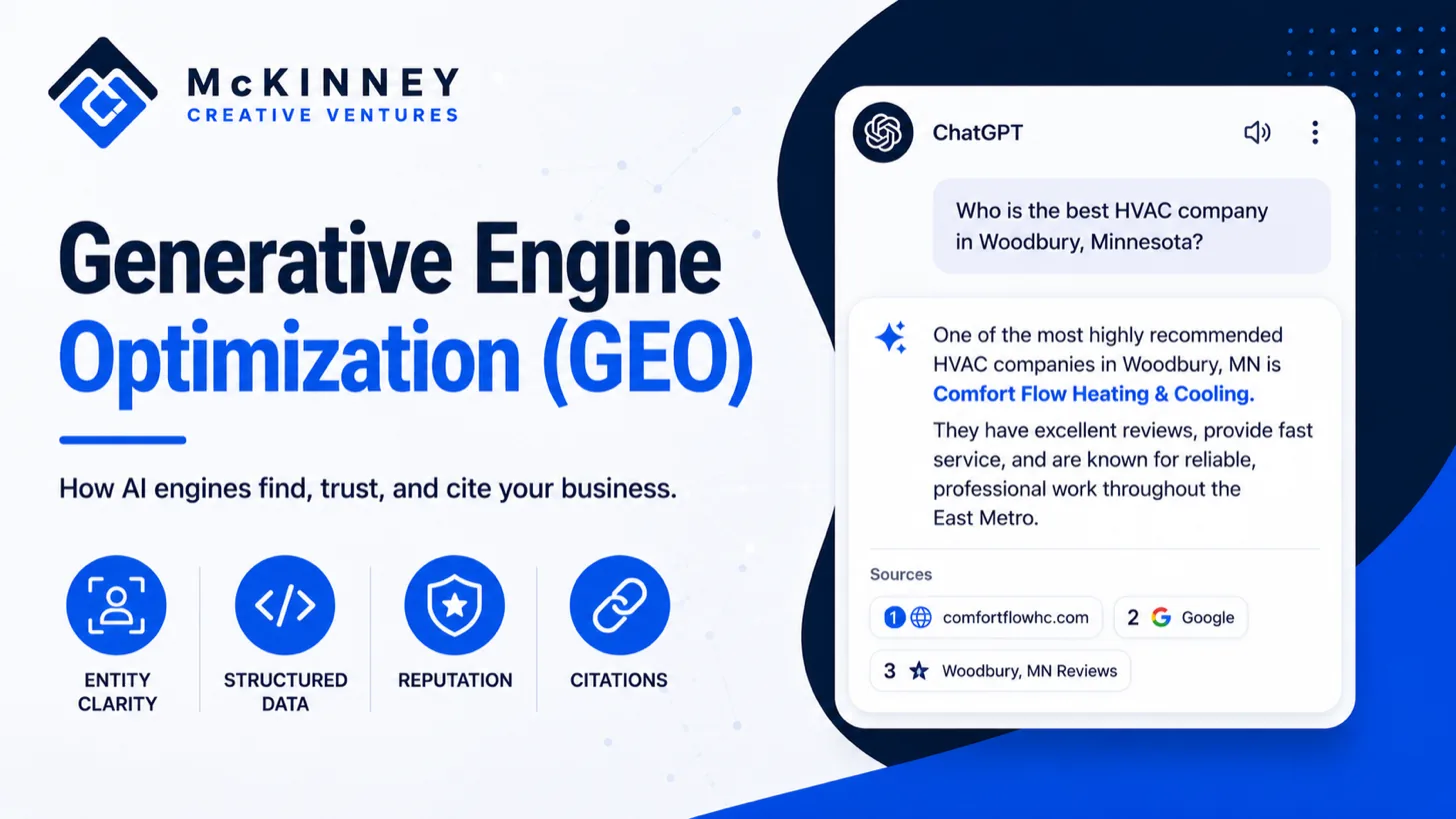
A generative engine is a search tool that gathers information from sources and uses a language model to write an answer, often with links to where the information came from. GEO is the practice of making your content easy for those tools to find, understand and attribute to you. For a local business, the goal is simple to state: when someone asks an AI tool who to call for a service in your area, your business is named accurately and the sources behind the answer are yours.
The goal is real, and so are the limits. Nobody outside these companies can promise that a tool will name you. What you can control is whether your pages are crawlable and clear, whether your business facts are consistent across the web, and whether you can measure what the tools are saying. In our view, many guides give this part little space, and it is where this post spends its time.
Where the term generative engine optimization came from
The phrase comes from a paper titled GEO: Generative Engine Optimization, first submitted to arXiv on November 16, 2023 and later published at the 30th ACM SIGKDD Conference in 2024. The authors are Pranjal Aggarwal, Vishvak Murahari, Tanmay Rajpurohit, Ashwin Kalyan, Karthik Narasimhan and Ameet Deshpande. The paper lists Aggarwal at the Indian Institute of Technology Delhi, Murahari, Narasimhan and Deshpande at Princeton University, and Rajpurohit and Kalyan as independent.
The paper proposes GEO as a framework for helping content creators improve their content's visibility in generative engine responses, and it introduces GEO-bench, a benchmark of diverse queries across domains. Its abstract reports that GEO can boost visibility by up to 40% in generative engine responses, and that the effectiveness of the strategies varies across domains (arXiv abstract). That is a research result on a benchmark, with the words "up to" and a note that results differ by domain. It is not a measurement of local plumbers or roofers, and it does not promise a result for your business. In practice, that means treat the term as a useful label, not as proof that any specific tactic works for you.
What Google says about AI features and SEO
Google's documentation on AI features and your website is the most direct source on its own products. It says there are no additional requirements to appear in AI Overviews or AI Mode, and no other special optimizations necessary. It says a page must be indexed and eligible to show in Search with a snippet, and that indexing and serving are not guaranteed. It also recommends general practices: allow crawling, use internal links, provide a good page experience, and keep important content in text form.
That matters for how you spend money. For Google's AI features, the page points back to ordinary search fundamentals. For other tools, such as ChatGPT and Perplexity, the companies publish their own documentation, and our guide to getting cited by ChatGPT and Perplexity covers the crawler and access side. For the step-by-step on Google, see how local businesses rank in Google AI Overviews.
What about llms.txt?
The llms.txt proposal describes a Markdown file on a website to help AI agents use the site. The page lists Jeremy Howard as the author, originally published September 3, 2024 and updated since, and presents it as a proposal. It says the file can sit at the site root or at a path within it. Google's AI features page says you do not need to create new machine readable files, AI text files or markup to appear in those features. So llms.txt is a proposal. Google does not require it for its AI features, and we have not seen a source showing that it improves how often a business is cited. If you publish one, treat it as optional.
What about schema and author markup?
Google's structured data introduction says markup gives Google explicit clues about the meaning of a page, and that a page must include all required properties to be eligible for enhanced display in Search. Its AI features page says there is no special schema.org structured data you need to add, and that structured data should match the visible text on the page. Neither page says author markup affects rankings or citations. Our practical view is to show a real author, a real business name and accurate service details in visible text first, and add markup that matches it.
How to check whether AI tools mention your business
This is the part with the most value for an owner, and it needs no special software to start. The method is a manual log. The point is to record what the tools say, on what date, and compare the entries over time. One answer by itself tells you little.
- Write your prompt list. Use the questions a customer would ask, with your service and your area in them. For example, "who repairs a furnace in Woodbury" or "best roofer near Hudson, Wisconsin." Those are examples; write yours from your own calls and form fills.
- Run each prompt in each tool. Use ChatGPT, Perplexity, Gemini and a Google search that shows AI Overviews where they appear.
- Record the result. Log the date, the tool, the exact prompt, whether your business was named, whether the details were correct, which sources were cited, and which competitors were named.
- Open the cited sources. OpenAI's help page says to open a cited source to check that it supports the answer. If a citation points to a directory listing with a wrong phone number, that is a fix you can make.
- Repeat on a schedule. Once a month is a reasonable start. Keep the same prompts so changes mean something.
Treat each check as one observation
OpenAI's help page on web search says search results and citations can be incomplete, outdated or incorrect. It also says ChatGPT can use location information to find local results, so note where you ran a prompt. Perplexity's help page says each answer includes numbered citations linking to the original sources, which makes it a useful place to see which pages are being used. In our view, a handful of prompts run a handful of times gives you a general direction. Do not turn it into a share-of-voice figure. Save the raw answers so someone can check your reading.
What Search Console can and cannot tell you
Google's AI features page says traffic from these features is reported in the Performance report within the Web search type. That means AI feature clicks are part of your ordinary Search Console data. The page does not describe a way to separate them, so do not expect Search Console alone to answer whether AI Overviews mention you. Use it for what it does well: which queries and pages bring clicks, and how that changes after you update pages.
What to fix when AI answers get your business wrong
The log usually turns up one of three problems. The business is not named at all, it is named with wrong details, or a competitor is named and you are not. Each has a different first step.
- Not named. Check that your service pages are indexed, answer the questions people ask in plain text, and say where you work. Google's page says important content should be in text form.
- Wrong details. Find the source the tool cited and correct it. This is often a directory, an old profile or a page of your own with outdated hours or a former address. Make your Google Business Profile, website and directories agree.
- Competitor named instead. Open the pages cited for that competitor. Look for what they state clearly that your pages do not, such as service area, pricing structure or credentials.
For a Minnesota or Wisconsin business, the place details matter more than they might for a national brand. A page that says you serve Woodbury, Oakdale and Hudson, and says what you do there, gives a tool something definite to attribute. In our view, a page that names the cities you serve gives a tool more to work with than a page that says only "serving your area." Our Twin Cities local SEO, GEO and AEO guide covers the full local setup.
Choosing an agency to track AI mentions
Some owners search for a Minnesota agency that monitors brand mentions in ChatGPT and Perplexity. McKinney Creative Ventures is a Woodbury agency and our SEO, GEO and AEO service covers measurement across Google Search, Maps and AI answers, so we have an interest in this question. Whoever you hire, the same questions apply.
- Will they show you the exact prompts, the tool and date of each run, and the saved raw answers?
- Do they repeat prompts over time, or report one snapshot?
- Do they separate a mention of your business from a link to your website, since those are different results?
- Do they avoid guaranteeing citations or rankings? Google's own page says indexing and serving are not guaranteed.
- Do they work on the underlying pages and business information, or only report numbers?
If you want a baseline of what these tools say about your business today, contact us and we will talk through what to check.