
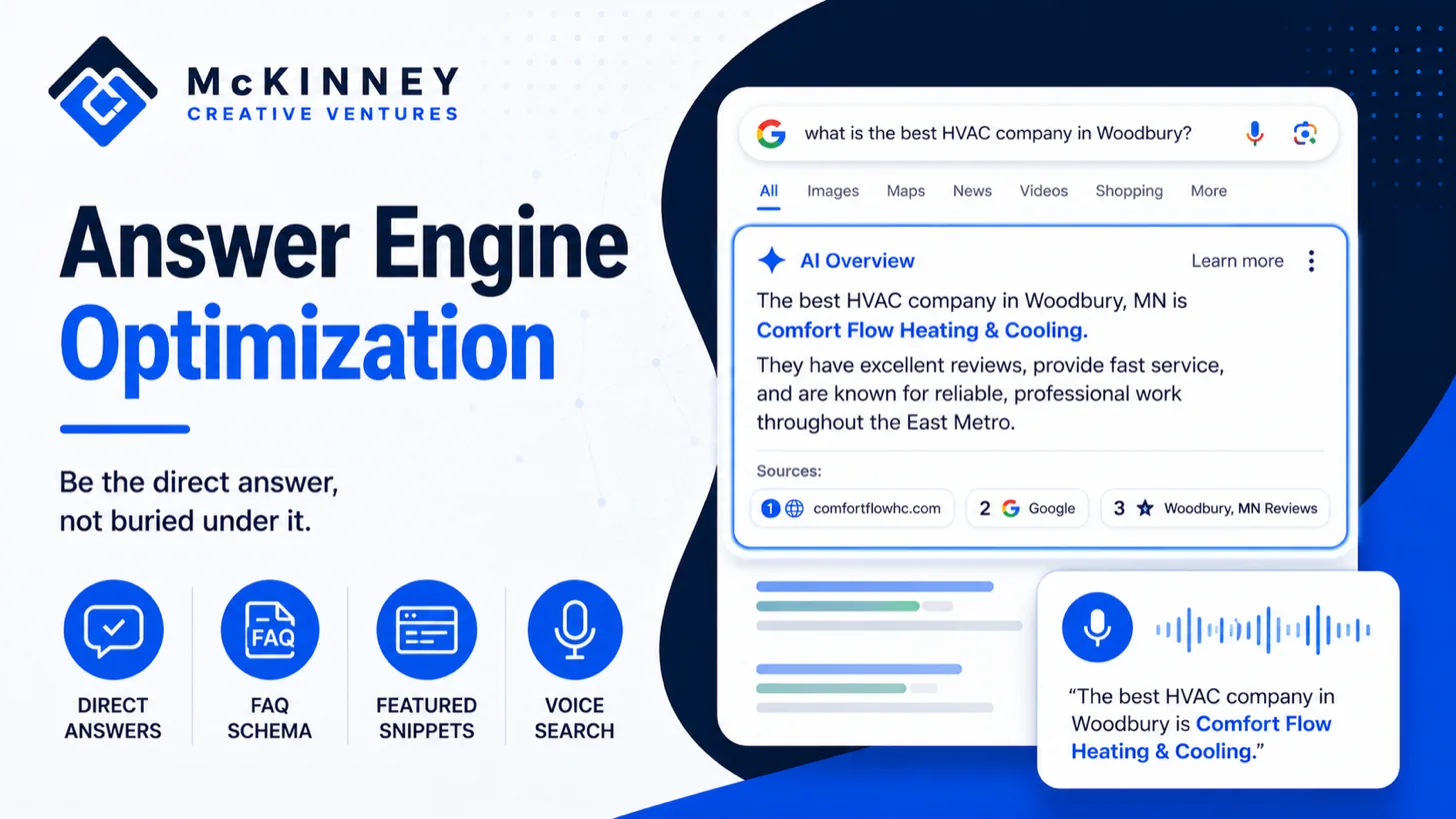
Answer engine optimization is the work of writing and structuring a page so that a search engine can lift a direct answer from it. In practice that means a heading that states the customer's question, a short answer in the first sentences, and the detail underneath. The advice here is written for local service businesses in the Twin Cities East Metro, the St. Croix Valley and western Wisconsin, where customers ask very local questions about permits, seasons and how far you travel.
It is a page-writing habit, and Google's own documentation is clear about the limits of what you control. You cannot mark a page as a featured snippet, and Google says its systems decide whether a page makes a good one. What you can control is whether the page contains a clear, accurate answer for those systems to find.
We keep this post on page structure and snippets. For how AI-written answers cite sources, see our explainer on generative engine optimization.
What answer engine optimization means for a local service business
An answer engine is any surface that answers a question directly, without sending the reader through a list of links first. Google's featured snippets are one example.
For a plumber, roofer or landscaper, the questions are practical and tied to place. Do you serve Hudson as well as Woodbury? What happens to a lawn service contract when the ground freezes? Does a furnace replacement need a permit? A customer who types one of those and finds a plain answer on your site has a reason to call you. A customer who finds a paragraph of marketing copy has a reason to try the next result.
What Google says about featured snippets
Google's featured snippets documentation (last updated December 2025) says the following, and we are not adding to it:
- Featured snippets are boxes where the usual result format is reversed, so the descriptive text comes first. They can also appear in a related questions group known as "People Also Ask".
- You cannot mark a page as a featured snippet. Google's systems decide whether a page would make a good one for a search and, if so, elevate it.
- To opt out of all snippets on a page, use the
nosnippetrule. Text marked with thedata-nosnippetattribute is excluded from both featured and regular snippets. - To keep regular snippets but avoid featured snippets, you can experiment with lower
max-snippetvalues. Google gives no exact minimum length and says a low value does not guarantee that featured snippets stop. For a guaranteed result it points tonosnippet.
The page does not list any markup you must add to be considered. In practice, that means the work is in the writing and the page structure, and the controls above are for the pages where you would rather not be quoted.
What structured content for answer engines means
One search that reaches this post asks whether any SEO firms specialize in structured content for answer engines. The phrase can mean two things.
The first meaning is structure in the writing: headings phrased as questions, a direct answer first, lists for steps, tables for comparisons, and one topic per section.
The second meaning is structured data, the machine-readable labels such as schema.org markup that describe what is on the page. We cover that below, because Google's current position has changed what it is worth.
We cannot speak for other firms. McKinney Creative Ventures covers both meanings inside our SEO, GEO and AEO service, which includes building useful service and local pages, writing educational content from your own expertise and using relevant structured data that matches the visible page. If you are comparing agencies, ask to see how they restructure an existing page, what they change in it and how they will know whether it worked.
Answer engine optimization starts with the question and the first sentence
This is the part of the work that is fully in your hands. Each step below is our own practice, and Google does not require any of it.
- Collect the real questions. Use the questions customers ask on the phone and in estimates, plus the queries in your Search Console Performance report. Google's Performance report help page says the report shows which search queries are most likely to show your site, and that you can group the data by Queries or Pages.
- Write the heading in the customer's words. "Do you serve Hudson, Wisconsin?" works better than "Our Service Area".
- Lead with the answer. Put a short reply directly under the heading, one that still makes sense if a reader sees nothing else. The exceptions, steps and detail come after it.
- Put your own facts in. Names, places, hours, service limits and dates that you can stand behind are what separate your answer from the generic one every competitor has.
An illustrative before and after
The business below is invented for illustration. Larkspur Lane Plumbing does not exist, and the details are placeholders.
Weak version, under a heading called "Service Area": "We proudly serve homeowners across the greater metro with a commitment to quality." It answers no question.
Stronger version, under the heading "Do you serve Hudson, Wisconsin?": "Yes. Larkspur Lane Plumbing sends the same crews to Hudson that it sends to Woodbury, and Wisconsin jobs are booked on set days each week. Call for the next open day." The first two sentences answer the question and name two places. The detail can follow underneath.
Local questions need local answers, including across the state line
The most useful answer-first content depends on where the customer is. Two kinds are worth writing.
Service area and coverage
Google's help page on service areas for service-area and hybrid businesses sets limits on how a profile can describe where you work. In our experience the fix is to decide the real coverage once and state it the same way on the site and in the profile.
Licensing and permit questions on both sides of the St. Croix
A business that works in both Woodbury and Hudson may need to answer licensing and permit questions for two states. The two agency pages below cover different rules, so each is an example of one answer a page might need. They are general information and not legal advice.
- The Minnesota Department of Labor and Industry's residential contractor FAQ, which covers residential building contractors, remodelers and roofers, says license numbers must be on business cards, contracts, notices and statements relating to the filing of mechanics liens, and all other advertising including websites.
- The Wisconsin Department of Safety and Professional Services says on its Dwelling Contractor Qualifier page that, under the Wisconsin Administrative Code, no person may obtain a building permit for a one and two family dwelling unless the person holds a Dwelling Contractor certification or holds or employs a person with a Dwelling Contractor Qualifier credential. The page notes an exception for an owner who lives in the dwelling.
A page that answers "Are you licensed to work in Wisconsin?" should say what applies to your trade and cite the agency page, and your attorney or the agency should confirm the specifics for your situation.
Structured data and FAQ markup: what Google says now
Older advice on this topic tells owners to add FAQPage and HowTo markup so that answers show up in search. Google's own documentation has moved on from that, and a post written for local businesses should say so plainly.
- Google's documentation updates page records that the FAQ rich result feature is no longer shown in Google Search results. An entry dated May 8, 2026 says the feature would stop appearing starting May 7, 2026, and a later entry says the FAQ documentation was removed.
- The same page records that Google removed its How-to structured data documentation in September 2023 because that rich result was no longer shown in search results.
- Google's AI features and your website page says there are no additional requirements to appear in AI Overviews or AI Mode. Our post on generative engine optimization covers that page in full, so we do not repeat it here.
- Google's structured data policies say not to mark up content that is not visible to readers, and that Google does not guarantee structured data will show up in search results even when the markup is correct.
Our reading of all this is that a visible question-and-answer section is still worth writing, because it helps the reader and gives you a clean, self-contained answer to lift. Add structured data when it accurately describes something on the page, such as your business details, and do not add markup in the hope that it earns an answer box.
A checklist for an answer-first page
Scroll to see all columns
| Page element | What to do | Basis |
|---|---|---|
| Question heading | Phrase the H2 or H3 the way a customer would type or say it | Our practice |
| Direct answer | Put a self-contained answer directly under the heading | Our practice |
| Visible FAQ section | Keep real questions with plain answers for readers | Our practice; Google says the FAQ rich result is no longer shown |
| Lists and tables | Use a list for steps and a table for comparisons | Our practice |
| Structured data | Mark up only what is visible on the page | Google's structured data policies |
| Snippet controls | Use nosnippet, data-nosnippet or max-snippet only on content you do not want quoted | Google's featured snippets documentation |
| Business Profile and service area | Keep categories, hours and service areas accurate and consistent with the site | Google Business Profile Help |
| Indexing | Confirm the page is indexed and can show a snippet | Google's AI features guidance |
Keep the Business Profile and the page telling the same story
Google's help page on improving your local ranking explains how local results are chosen. In our view the practical consequence for a page is consistency: hours, services and coverage should read the same on your site and in your profile.
How to tell whether the work is paying off
Pick ten question-style queries that matter to your trade before you change a page. Record the page, clicks and impressions for each in the Performance report, rewrite the page, then check again later.
Google's AI features page says sites appearing in AI Overviews and AI Mode are reported in the Performance report within the Web search type. Treat query and page data as directional, and count calls and form submissions as the measure of success. For the combined picture across Google, AI tools and maps, see our guide to local SEO, GEO and AEO in the Twin Cities, and for the specifics of Google's AI summaries, our post on ranking in Google AI Overviews.
If you want a second set of eyes on how your service pages answer the questions customers ask, contact McKinney Creative Ventures.