
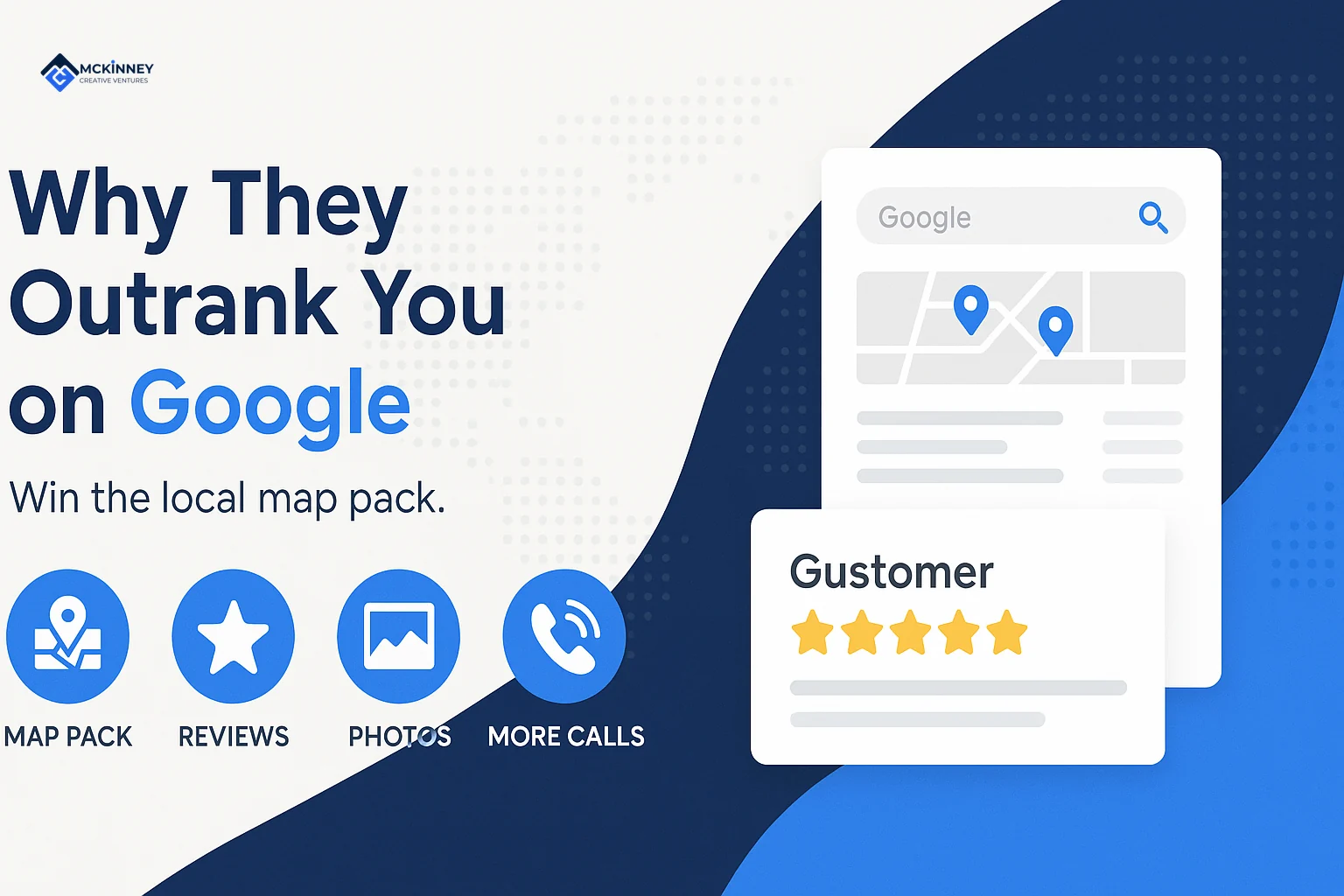
The Google map pack is the set of local results Google shows, usually with a map, when someone searches for a nearby business. Google's own help pages call these local results on Google Maps and Search, and we use "Google map pack" for the same thing. This post goes with Tech Tips Tuesday episode 3 and is for owners in the Twin Cities East Metro and the St. Croix Valley who keep seeing the same competitor above them.
The episode asks why that happens. We compare two listings side by side, item by item, and sort every difference into what you can change and what you cannot. Google does not publish how it weighs its factors, so we do not claim to know why any one business ranks first, and we promise no result. The example business below is invented.
What Google says shapes the Google map pack
Google's page on improving your local ranking says local results are mainly based on relevance, distance, and popularity, and that together these help Google find the best match. Under its headings, relevance is how well a Business Profile matches what someone is searching for. Distance is how far each business is from the person searching, and Google uses what it knows about their location when they do not share it. Prominence, the page's third heading, means how well-known a business is, based on information such as how many websites link to it and how many reviews it has. The page says more reviews and positive ratings can help, and that there is no way to request or pay for a better local ranking.
The page gives no weights, and we will not invent any. In our reading, it still sorts the comparison. You cannot change distance, you can improve how well your profile matches the search, and prominence builds slowly through links and reviews that you earn.
Step one: find where the search happened
Compare nothing until you know where the search came from, because distance is measured from the searcher. Google's page on managing your location says your location helps show nearby results even when you did not type one, and that it is estimated from several sources used together. At the bottom of a results page, Google says how it estimated yours, with lines such as "From your device," "Based on your past activity" and "From your internet address." If results are not local, the page suggests adding a place to the search.
This matters in our corner of the metro. A search for a plumber from a phone in Woodbury and the same search from a phone in Hudson, Wisconsin start from different places, and Google names distance as a factor. In our view, the two packs can differ for that reason alone, and a service-area business that works on both sides of the St. Croix competes in both. Google's pages give no example of this, so treat it as the logic of the factor and test it yourself. Run the same search from your shop, from home and from a town you serve. A competitor who leads from your shop and falls back from a customer's driveway has an advantage that a better profile does not fix.
The side-by-side comparison
Open your listing and the competitor's in two tabs and work down the table. Each row says what to look at, where to see it and whether the difference is yours to change. Our Google Business Profile optimization guide covers how to fill in every field, so this post stays on comparing.
Scroll to see all columns
| What to compare | Where you can see it | Can you change it? |
|---|---|---|
| Distance from the searcher | The location line at the bottom of Google's results page, and the pins on the map | No. You can only keep a true address and service area |
| Primary and additional categories | The category each Google listing shows | Yes, if the categories are accurate; you cannot create your own |
| Review count, rating and recency | The review section of both listings | Partly: you can ask honestly and reply, and customers decide what they write |
| Business name | The listing, set against their truck, signage and website | Yours, yes; theirs only through Google's redressal form for suspected fraud, which promises no action |
| A website page for that service and town | Their site, found by searching the service plus the town | Yours, yes |
| How well known they are | A search for their name and where else they are mentioned | Slowly, through reviews and links you earn |
| What sits above the pack | The results page, where Google's Ads help says ads above organic results carry a "Sponsored" box | Not through your profile. Google's ad programs have their own rules, and Local Services Ads require screening and verification |
Categories
Google's page on business categories says the categories you select affect your local ranking and that you cannot create your own. Google's guidelines say to use as few categories as possible to describe your core business and not to use categories solely as keywords. Check the category each listing shows. If the listing above you has a category that matches the search more closely and yours is general, that is a gap you can close, provided the category is true of your business.
Reviews
Google says more reviews and positive ratings can help a business's local ranking, and its review tips say you can ask customers to use a Google link or scan a QR code and recommend replying to reviews. The same page calls offering incentives for reviews strictly prohibited. The Google pages we read do not name recency as a ranking factor. We still compare it, because a customer scanning two listings will notice a competitor with reviews from last month and yours from two years ago. That is our view. You cannot choose what customers write, but you can ask every customer and reply to each review.
Business name
The guidelines say a name should reflect the business's real-world name, as used consistently on its storefront, website and stationery and as known to customers. They also say unnecessary information in a name is not permitted and could result in a suspension. Compare the competitor's Google name with the name on its truck and website. If they match, there is nothing to report. If the Google name carries extra service or town words that the real-world name does not, the guidelines above are the rule that applies. We cannot tell from a listing whether Google will act on a report.
Google's Business Redressal Complaint Form is for misleading information or fraudulent activity related to the name, phone number or URL of a business on Maps. Google says it cannot guarantee that any action will be taken, that you will not be updated on the complaint's status, and that it will not review a complaint that is not about fraudulent activity in those fields. For a simple correction, it says to use the regular edit steps. Its page on reporting a business points to the same form for suspected fraud. The pages we read describe no separate path for a name that breaks the naming guidelines without any sign of fraud. Save screenshots and photograph the truck first. Keep your own name clean, and our guide to avoiding a Business Profile suspension covers the name rules in detail.
Website
Google's page on how it sources profile information says profiles are compiled in part from crawled web content such as a business's official website. Google does not say how much weight that carries in the Google map pack, so this row is our judgment. Search for the competitor's service plus your town and see whether it has a page that names both. Then check whether you do, and write that page only if you do that work in that town.
Above the pack
Google's Ads help says the ads above organic results contain a "Sponsored" box, and Google's October 2025 announcement says text ads are grouped under a single "Sponsored results" label. Local Services Ads have their own help pages. Google's ad ranking page says provider listings there are ranked by an auction that weighs your bid, how likely your ad is to produce a lead, including how you respond, and profile quality, which covers rating, number of reviews, response time, images and verification checks. The pages we read do not say where those listings sit on the results page. In our reading, a competitor in that program is in a different contest from the one the local ranking page describes. Our Local Services Ads setup guide covers the screening and setup steps.
A worked example with an invented competitor
Suppose a plumber in Woodbury searches "plumber near me" and finds Fennimoss Plumbing first. Fennimoss is invented, and so are the findings. The location line says the search used the phone's device location, and Fennimoss's address is a few minutes from the phone, so distance may explain part of the order, and nothing can be done about it. Both listings share the same primary category. Fennimoss has more reviews and a recent one. Its Google name matches its truck, so there is nothing to report. Its site has a page for water heater replacement in Woodbury, and the plumber's does not.
That leaves three changes worth making: ask every customer for a review, reply to each one, and write the missing page. None of them is a guarantee, and the comparison can only tell you where the gaps are.
Your action step for today
Choose the one search that matters most to your business and run it from your shop, from home and from a town you serve. Fill in the table for the top competitor, circle the rows you can change, and pick one. If you want a second opinion on the comparison, contact us. Our SEO, GEO and AEO work helps small businesses and solopreneurs across the East Metro and St. Croix Valley become easier to find and evaluate, with accurate local information and clear measurement across Google Search, Maps, and AI answers.