Brand & Copy
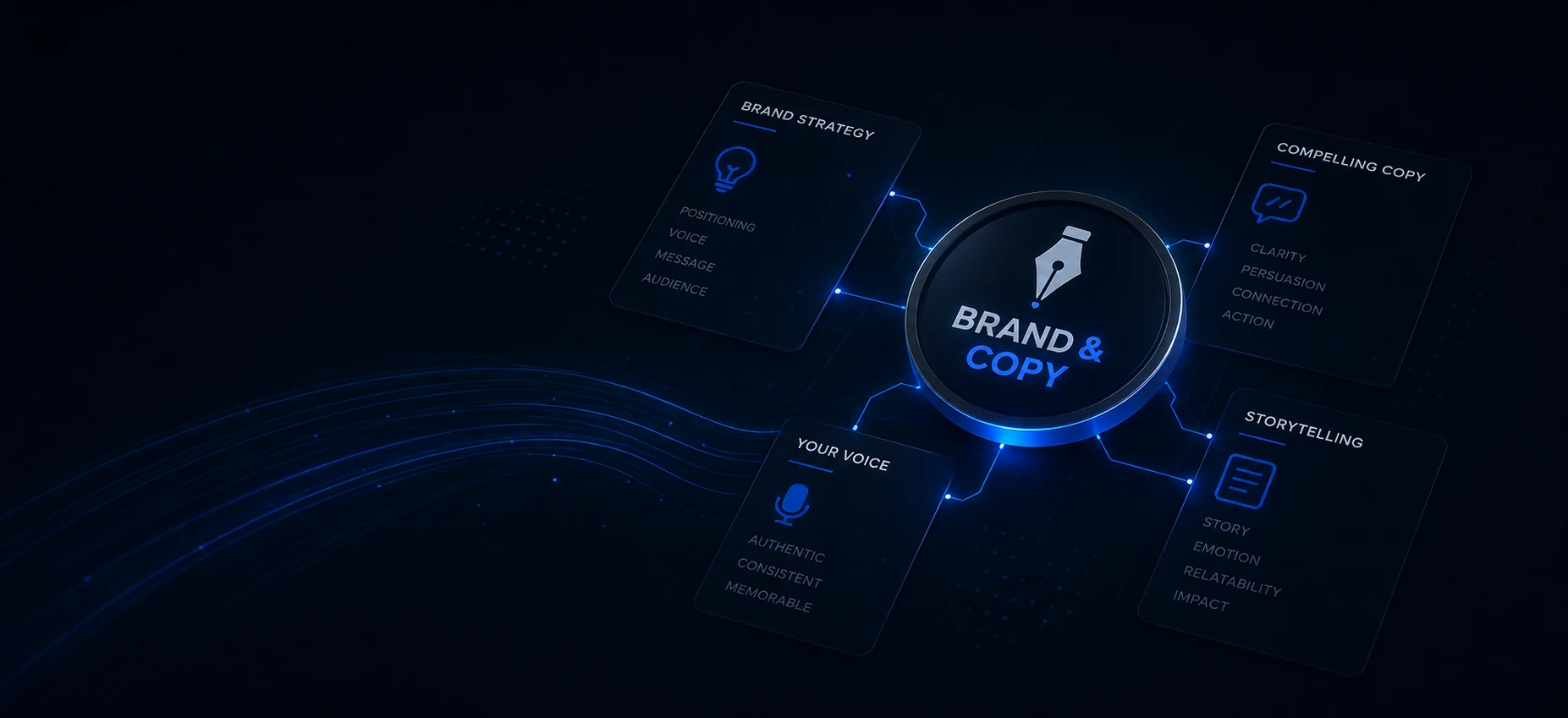
A logo you are proud to put on the truck, and words that sound like your business. We bring identity and copy together so the brand works everywhere it appears.
Why the Brand Stops Working Before the Business Does
Logos, brand identity, rebrands, and the words. Site copy, blogs, and proposals written to sound like you and sell the work.
A Logo From 2009
A mark somebody's nephew made in an afternoon, now stretched onto trucks, shirts, and a website it never fit.
Nothing Matches
Different colors on the truck, the sign, the invoice, and the site, so nobody connects them to one business.
Copy That Sounds Like Everyone Else
Pages of quality service and customer satisfaction that say nothing a competitor could not also claim.
The Blog That Stopped
Three posts from two years ago. Search and AI engines both need something current to read and cite.
Who Brand & Copy Work Is Actually For
Brand and copy is the one service where we turn down the most work, because it only pays off when there is a real business underneath it. If you do good work and your marketing makes you look like everyone else, this fixes a genuine gap. If the work itself is the problem, a new logo will just make the wrong impression faster.
This is a good fit if
- Established local service businesses whose reputation is better than their branding. You have the reviews, the repeat customers, and the crew, and the logo still looks like a favor somebody did you in 2009.
- Owners going through a real change: a name change, a merger, an acquisition, a second location, a son or daughter taking over, or a split from a franchise you no longer want to be confused with.
- Businesses that have a website but nobody who can write for it. The pages have been half finished for a year because writing them keeps landing at the bottom of your list.
- Companies that already have a decent mark and need everything else to match it: the truck, the shirts, the invoice, the yard sign, the Google Business Profile, and the site all pointing at one identity.
- Owners who want a blog that actually gets read and cited by search and AI engines, written by someone who understands the trade and will call you to check a technical detail before publishing.
This is probably not for you if
- Anyone shopping for a fast, cheap mark. If the goal is a logo by Friday for as little as possible, a design contest site will beat us on both price and speed, and we will tell you that on the call instead of taking the job.
- Businesses that want us to invent a differentiator they do not have. We write what is true. If nothing separates you from the shop across town yet, that is an operations conversation before it is a copy conversation.
- Anyone who wants high volume keyword stuffed articles pushed out weekly. That approach stopped working, it puts your site at risk, and we will not build a content program around it.
What You Get
What You Actually Get
Scope flexes because some businesses need the whole identity and some only need the words. Here is the full menu of what we deliver, and on our call we pick the parts you actually need instead of selling you the package.
A Complete Logo Set, Not One File
Primary mark plus horizontal, stacked, icon only, one color, and reversed versions, delivered in SVG, PDF, PNG, and JPG. That covers the website header, the browser tab, embroidery, vinyl on a truck door, and a dark background, without anyone stretching or recoloring anything.
Brand Standards Document
Exact hex, RGB, and CMYK values, fonts with licensed web and print fallbacks, clear space rules, minimum sizes, and a short do not do this list. It is the file you hand a sign shop, an apparel printer, or the next person who touches your marketing.
Real World Application Proofs
The mark shown on a truck, a yard sign, a shirt, an invoice, and a business card before anything gets printed. Logos that look great on screen fall apart at eight feet and forty miles an hour, so we test them there first.
Page by Page Website Copy
Every page written in full, with the H1 and H2 structure, title tag, and meta description included, not a wall of text you have to figure out how to place. Home, services, service areas, about, and contact all written to move somebody toward a call.
A Written Voice Guide
The phrases you actually use, the words you never use, sentence rhythm, and how you talk about price, warranties, and competitors. This is what keeps your copy consistent when someone else, or an AI tool, writes the next thing.
Blog Articles Built to Be Cited
Long form pieces structured as real questions with direct answers, so search engines rank them and AI answer engines can quote them. Every technical claim gets checked with you before it publishes.
Sales Documents in Your Voice
Proposal, estimate, and service agreement templates written to read like you and close, plus the follow up email and text templates that go with them. You get editable files, not a locked PDF.
Off Site Copy Nobody Remembers to Write
Google Business Profile description and services, review request messages, ad headlines, and the email signature block. These are the touchpoints that quietly contradict a new brand if nobody updates them.
How a Brand and Copy Project Runs
Voice Capture Call
We record you talking about your work instead of sending you a questionnaire.
We get on a call and ask about a job you were proud of, a customer you turned away, what your competitors get wrong, and what you say to a homeowner standing in their basement. We record it and pull the phrases you repeat without noticing. Your job is one hour of honest talking, and any existing files you have: old logo art, photos, license numbers, and anything a previous designer sent you.
The Positioning Line
We settle on the one true thing a competitor cannot copy before a single pixel gets drawn.
We come back with two or three positioning options pulled from what you told us, each one a sentence you could defend to a skeptical customer. You pick one, or you tell us all three are wrong and why, which is just as useful. Everything after this step, the mark, the headline, the blog topics, gets judged against that line, so this is the gate that matters most.
Marks, Then Proofs
Logo concepts get tested on a truck door and a shirt pocket before you ever approve them.
You see a small number of genuinely different directions, not twelve variations of the same idea, and each one comes with a real world proof so you are judging it at the size customers see it. We do focused revision rounds on the direction you choose rather than endless small tweaks across all of them. If you are hiring us for words only, we skip this step entirely and go straight to copy.
Copy Pass, Page by Page
Every page gets written in order, with the sales structure and the search structure built in at the same time.
We draft in a shared document so you can comment inline, and we flag any factual claim in yellow for you to confirm or kill. Warranties, license numbers, response times, years in business, and anything about a competitor gets verified by you before it goes live. Expect one full pass, your notes, and one revision pass per page, which is usually enough because the voice work was done in step one.
Rollout and Handoff
Files, standards, and a sequence for changing things over without confusing your customers.
You get the full file set, the standards document, and a phased rollout order: digital first, print as it runs out, vehicles last, because vehicle wraps are the most expensive thing to redo. We update the website, Google Business Profile, and CRM templates so nothing still shows the old identity. If we also run your site, search, or ads, the new copy and mark flow into all of it without another handoff.
A Brand You Are Proud to Put on the Truck.
Original identity work and copy written in your voice, not filler that could belong to anyone.
Worth Understanding
What Local Branding and Copy Actually Come Down To
Most of what gets sold as branding is decoration. Here are four things that decide whether an identity and a set of words earn you work, none of which come up in a typical design proposal.
A logo is a system, not a picture
The mark that looks sharp at full width on a laptop is usually the one that turns to mud on a shirt pocket and a truck door read at forty miles an hour. A working identity is a set: a horizontal lockup for a website header, a stacked version for square spaces, an icon that still reads at sixteen pixels in a browser tab, a single color version for embroidery and cut vinyl, and a reversed version for dark backgrounds. Vector files, meaning SVG and PDF, scale from a business card to a billboard with no loss, while a PNG or JPG does not. If a designer handed you one JPG, you do not have a logo, you have a photograph of one, and every sign shop you hire will charge you to redraw it.
The competitor test kills most website copy
Take any sentence on your homepage and ask whether the shop across town could paste it onto their site without changing a word. Quality service, customer satisfaction, family owned, free estimates, satisfaction guaranteed. All of it is true of everyone, which means it separates no one, and a homeowner comparing three tabs reads all three as identical. The lines that actually sell are the ones only you can say: the license number, the specific neighborhood you have worked in for eighteen years, the job you refuse to take, the technician who has run the same route since 2011. Specificity is not a writing style, it is the entire mechanism by which a stranger decides you are the safer call.
AI answer engines quote structure, not adjectives
When someone asks ChatGPT or reads a Google AI Overview about who to call in their town, the engine is pulling sentences from pages that answer a question plainly and immediately. That means an H2 written as the literal question a customer asks, then the answer in the first two sentences underneath it, then the supporting detail. The common mistake is two paragraphs of throat clearing before the answer, which buries the only quotable part of the section. We write the answer first and the persuasion second, which happens to also be what a person skimming on a phone in a parking lot needs.
Your voice already exists, it is just not written down
Almost every owner we work with explains their business perfectly on a phone call and then writes like a brochure the second they open a blank document. That is why we record a conversation instead of sending a branding questionnaire full of questions like what are your core values. The phrases you repeat, the analogies you reach for, the thing that visibly irritates you about how competitors operate, that is the voice, and it is already fully formed. Everything after that is transcription and editing, which is the reason the finished copy sounds like you and not like an agency wrote it about you.
Frequently Asked Questions
Will I lose the recognition I have built if I change the logo?
Do I own the logo when we are done?
Can you write copy for a website you did not build?
Do you use AI to write my content?
Will rewriting my site copy hurt my current search rankings?
Do I actually need a blog in 2026?
How many logo concepts and revision rounds do I get?
Do I have to rebrand everything at once?
Can you match a brand I already have instead of changing it?
Listen
Story, Words, and the Five-Second Test
A short episode on whether a stranger can tell what you do, another on writing review replies without falling behind, and a full conversation about telling a business story.
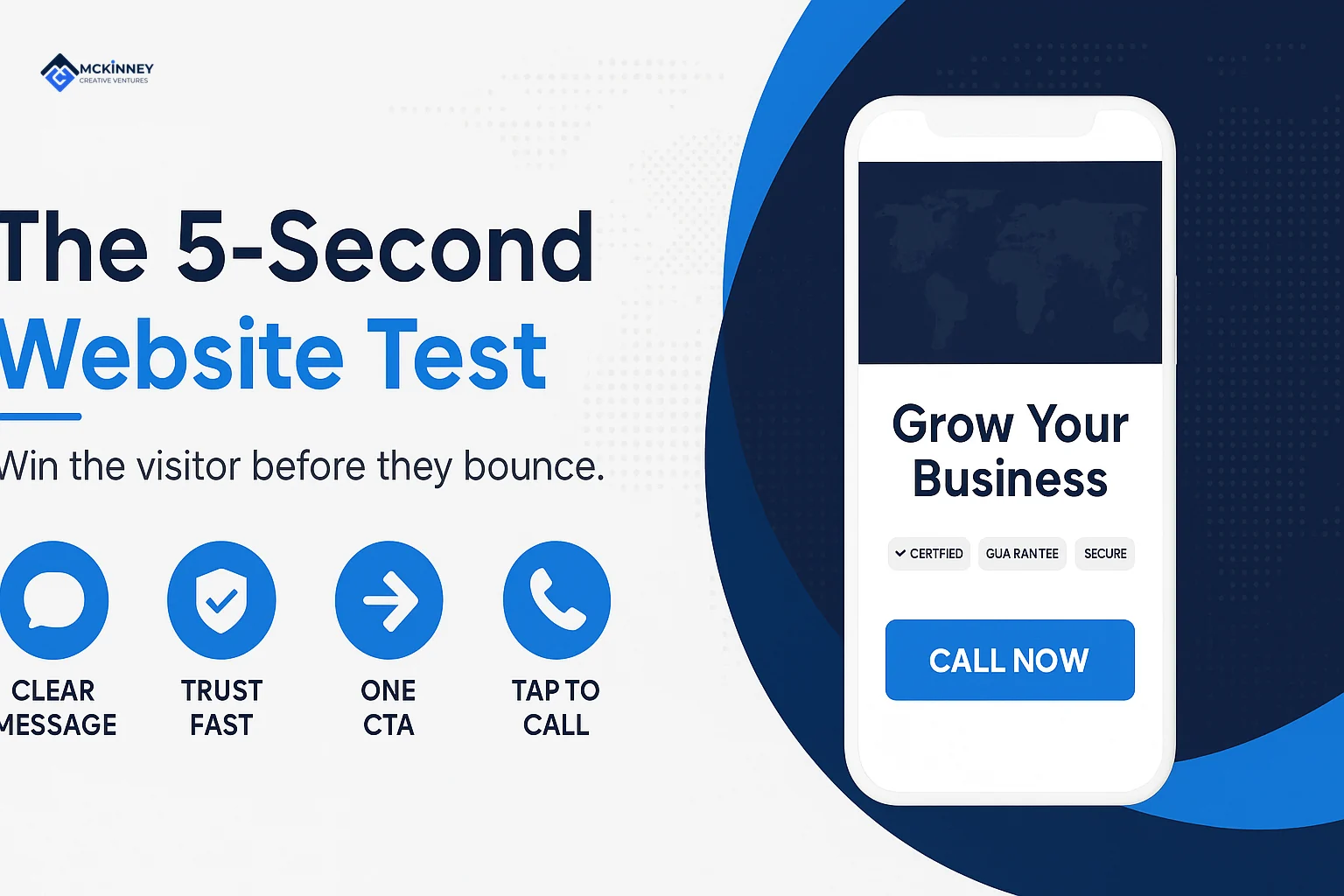
The 5-Second Website Test
If a stranger cannot say what you do and who you do it for in five seconds, the problem is almost always the words and not the design.
Episode 5 · 3:56
Henry Schneider of Open Window Productions: Storytelling, Skate Shops, and the Business of Video
An hour with Henry Schneider of Open Window Productions on storytelling and the business of video, which is the same problem copy solves in text instead of footage.
Episode 3 · 1:00:33
Answer Every Review in Two Minutes (with AI)
Every review reply is public writing in your voice. This is how to keep up with all of them without sounding like a form letter.
Episode 6 · 3:24More on Brand & Copy
We write up what we learn doing this work. These articles go deeper than a service page can.
The 5-Second Website Test
Before you spend a dollar on a logo, run this test on your homepage. If a stranger cannot say what you do and who you do it for in five seconds, the problem is the words, not the design.
Read the article
7 Small Business Website Mistakes Quietly Killing Your Conversions
Most of these are copy problems wearing a design costume. Worth reading before you assume the site needs a rebuild.
Read the article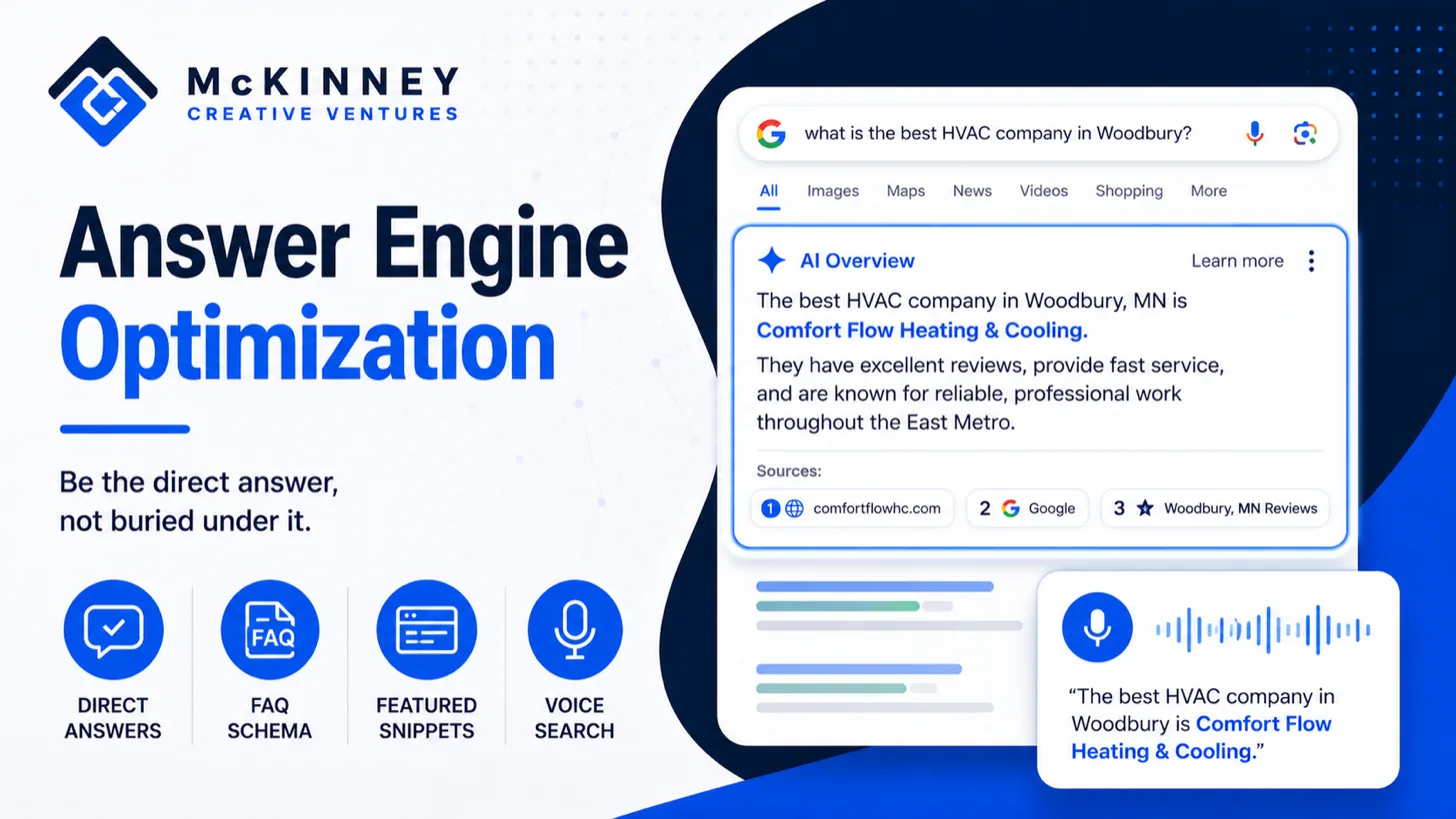
Answer Engine Optimization for Local Service Businesses: The New Rules of Getting Found
This is the structure we use for every blog post and service page, and why the answer goes first instead of last.
Read the article
Modern Website Design for Local Service Businesses: What Actually Converts in 2026
Where the brand and the words have to land once they exist. Read this if the rebrand is heading toward a new site.
Read the article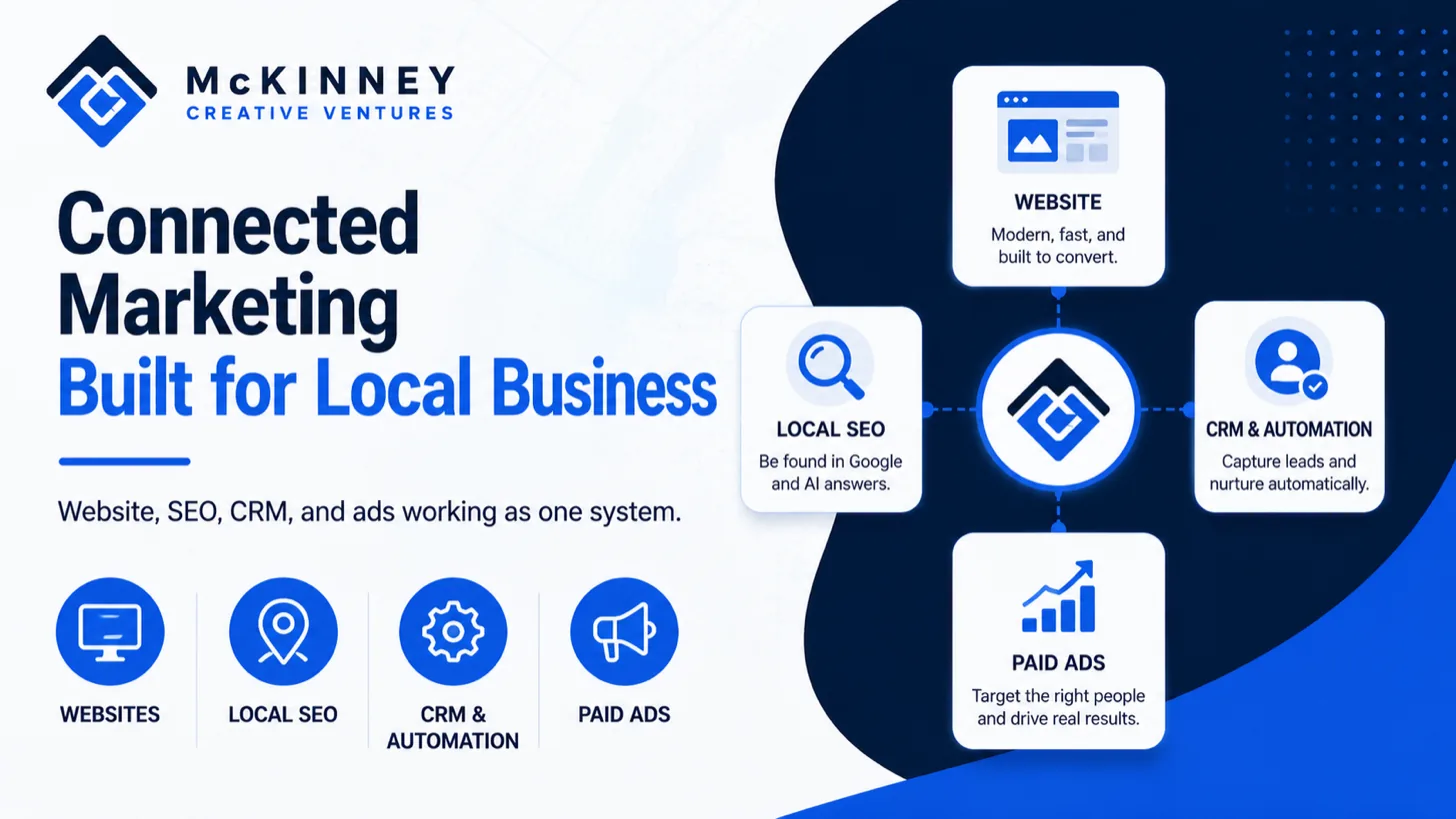
Meet McKinney Creative Ventures: Connected Marketing Systems Built for Local Service Businesses
Who you are hiring, how we are built, and how we work. Read it before you book the call.
Read the article