

Digital marketing cost for small business depends less on a single price than on how each service is priced and what is included. A website is usually a project fee. SEO is usually a monthly fee for ongoing work. Paid search has two parts, the ad spend you pay Google and the management fee you pay whoever runs the account. Local Services Ads charge per lead. Knowing which structure you are looking at is the first step to comparing quotes.
This guide is for owners of service businesses in the Twin Cities East Metro, the St. Croix Valley and western Wisconsin who are reading proposals or deciding whether to hire in-house. It stays on what each service costs and why. If your question is how much of revenue to set aside for marketing overall, our guide to the marketing budget for a local service business covers that.
We do not publish agency price ranges here, because we have not found a named, dated survey of agency fees that we can verify, and a number without a source is a guess. Where a figure appears below, it comes from the page linked beside it.
How digital marketing cost for small business is structured
Most quotes use one of the structures in the table. Two quotes with the same total can buy very different things, so ask which structure each one is and what sits outside it.
Scroll to see all columns
| Pricing structure | What you are paying for | Where it fits | What to ask |
|---|---|---|---|
| Monthly retainer | Ongoing work by a named team or person | SEO, content, ad management, email and CRM upkeep | What is included each month, and what counts as extra? |
| Project fee | A defined deliverable with a start and an end | A new website, a rebrand, a tracking setup | What happens after launch, and who pays for hosting and updates? |
| Hourly or consulting | Time, usually for advice or a small fix | Audits, training, one-off problems | Is there an estimate or a cap on hours? |
| Ad spend plus management fee | Media paid to the platform, plus the labor to run it | Google Ads and social ads | Is the ad account in your name, and is the fee flat or tied to spend? |
| Per lead | A charge each time the platform counts a lead | Local Services Ads | What counts as a billable lead, and how are disputes handled? |
| In-house hire | Salary, benefits and tools for one employee | A business with steady, varied marketing work | Can one person cover design, ads, content and reporting? |
Ad spend deserves special attention. It is not part of an agency fee. It is the money that goes to Google or another platform, and it should be visible in a statement that comes from the platform as well as in the agency invoice.
What drives the price of each service
Website design
A website is mostly scope. The price moves with the number of pages, whether the design is custom or built from a template, how much copy and photography has to be created, and which integrations are needed, such as booking, payments, forms that feed a CRM, or separate pages for each service and each city you serve. Ask what is not in the fee: hosting, security updates, edits after launch and a plan for who owns the domain and the accounts. A cheap build with an expensive maintenance plan can cost more over time than a higher project fee that includes upkeep.
SEO
SEO is mostly labor. Google's own page on whether you need an SEO says it costs nothing to appear in Google's organic results and that advertising with Google has no effect on your site's presence there. It also says that no one can guarantee a number one ranking, and it suggests asking a prospective SEO what results they expect, in what timeframe and how they measure success. Those are also the questions that explain the price. The cost drivers are the number of locations and service lines, how competitive the searches are, the condition of the current site, how much new content is needed and how much tracking has to be set up. A retainer buys the hours to do that work every month, which is what our SEO, GEO and AEO service is built around. It does not buy a ranking.
Paid search with Google Ads
Paid search is the clearest case of two bills. You pay Google for the clicks, and you pay a person or agency to build and manage the campaigns. Google's help page on maximum cost-per-click bids explains that you set a maximum bid, that a click won't cost more than that maximum, and that what you actually pay is called the actual CPC. The page on overdelivery and average daily budgets adds that on a given day a campaign might spend up to twice its average daily budget, and that over a month it will have spent no more than 30.4 times the average daily budget. So a daily budget is an average, and a monthly figure is a ceiling you set on purpose.
We are not quoting local click prices. The price of a click comes from an auction that changes with your service, your area and your competitors, and we have no sourced local figure to give you. Ask your manager to show actual click costs from your own account instead. Our digital advertising management is built around that kind of reporting.
Local Services Ads
Local Services Ads work differently. Google's page on how bidding works for Local Services Ads says you only pay when you get a lead, that your weekly budget affects how many leads you could get, and that you can choose maximize leads, a target cost per lead or a maximum per lead. The bid sets the most you would pay for a lead. Our Local Services Ads setup guide covers the screening and verification process.
Email, text and CRM
Email and text follow-up usually costs a software subscription plus the setup and upkeep of lists, templates and automations. Plan prices change often, so we are not listing any here. The larger cost is usually the labor to keep contact records clean and to track which messages produced booked work. Consent rules for email and text also affect how you can use the list, which is a question for your attorney.
Social media and content
Social and content work is priced by output and by who creates it. Posts written from a template cost less than original photography, video or case-study writing, and organic posting costs mainly time. If an agency quotes a number of posts per month, ask what the posts are meant to do and how you will see the result.
In-house or outsourced
The cost of an in-house hire is more than a salary. The U.S. Bureau of Labor Statistics Occupational Employment and Wage Statistics for May 2025 list Minnesota median annual wages of $87,510 for market research analysts and marketing specialists, $173,300 for marketing managers, $101,020 for web developers and $63,860 for graphic designers. Those are wages only. Benefits, payroll taxes, software and training are extra, and our own point is that one person rarely covers design, paid search, SEO, content and reporting equally well.
Outsourcing trades a fixed salary for a fee that can scale up or down, and it gives you access to several skills at once. The tradeoff is that someone outside the business has to learn it, and you need clear ownership of the accounts. Neither choice is cheaper in every case. A business with steady, varied work and the management time to supervise may do well with a hire. A business with a defined project or a narrow need often does better with an outside team.
What a proposal should show before you sign
Use the same checklist on every quote, whether it comes from an agency in the Twin Cities or a freelancer across the St. Croix.
- Scope in plain terms. What is delivered, how often and by whom.
- What is excluded. Hosting, content, photography, ad spend, tools and edits are common gaps.
- Term and exit. The length of the commitment, how to cancel and what you keep if you leave.
- Account ownership. Your domain, analytics, ad accounts and Google Business Profile should be in your name.
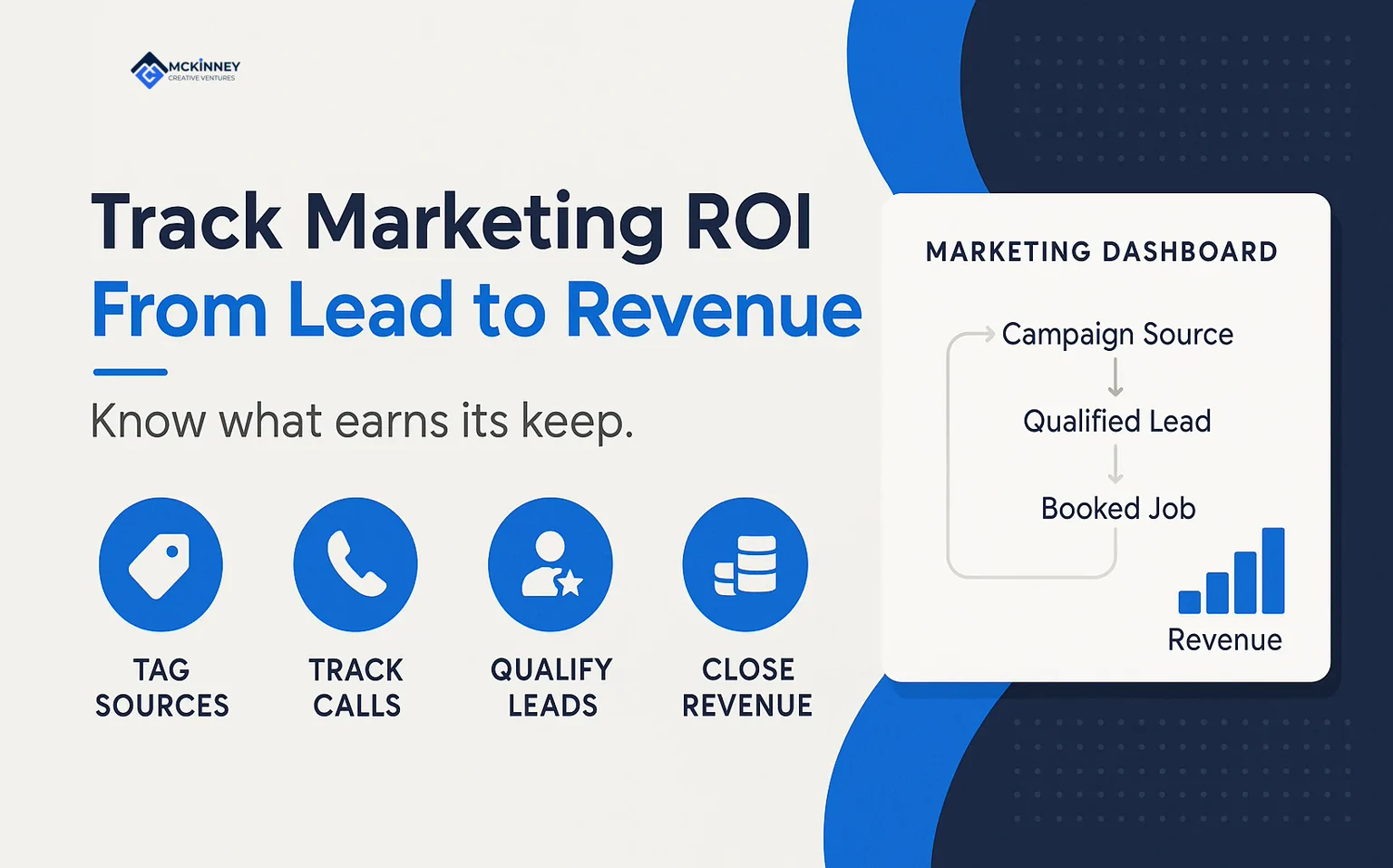
- Reporting. Calls, forms and booked jobs, along with impressions and clicks.
- No guaranteed rankings. Google's page on hiring an SEO says to find someone else if they guarantee first place.
If you serve both sides of the river, ask whether the proposal covers service areas, pages and listings for both Minnesota and Wisconsin, since the two states may have different licensing and permit rules you will want reflected in your copy.
If you want a second opinion on a proposal you already have, contact us and we will go through the scope with you.