
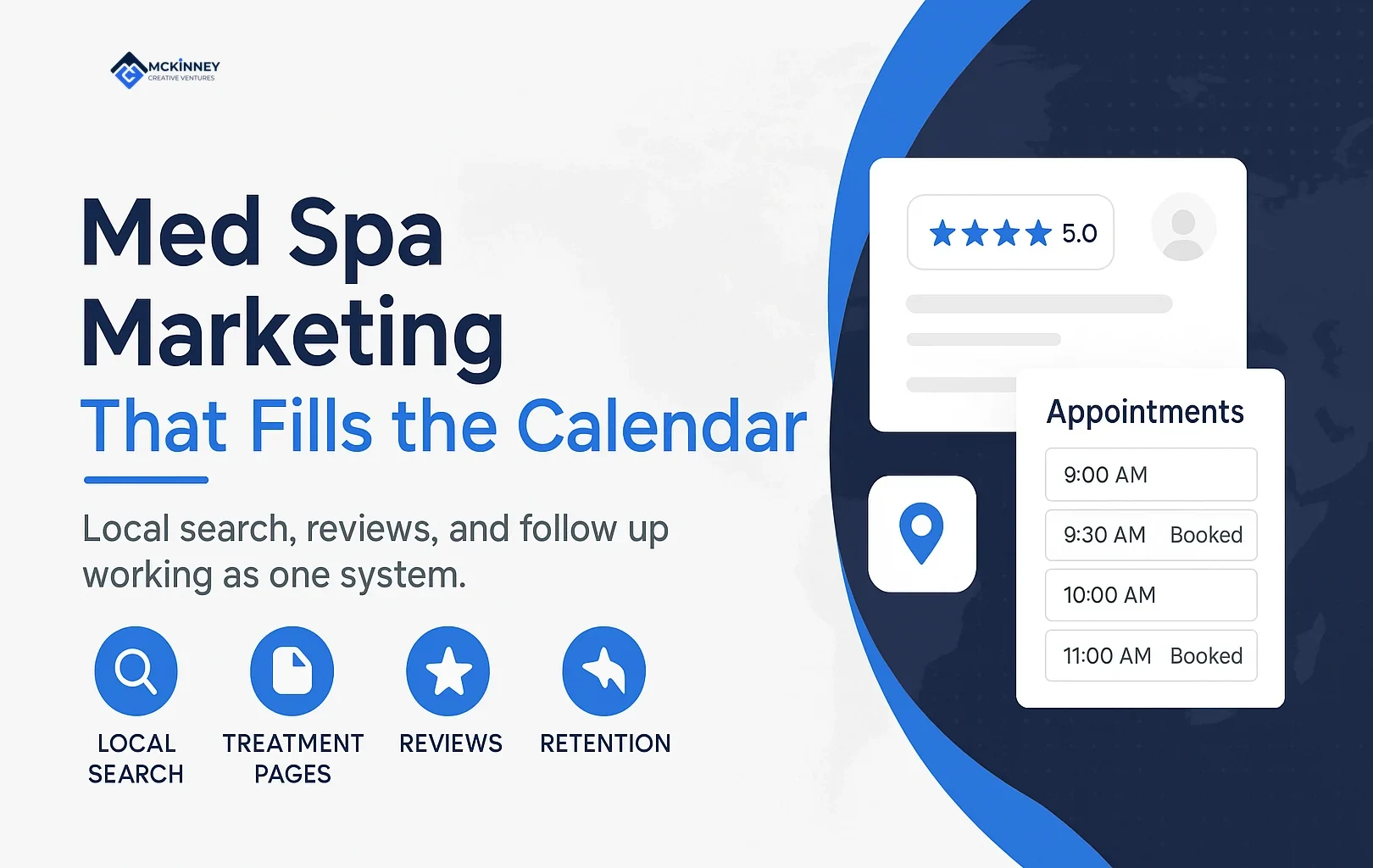
Med spa marketing in the Twin Cities comes down to four connected parts: a Google Business Profile that follows Google's rules, a page for each treatment you want to be found for, a review process that follows both Google's and the FTC's rules, and follow-up that brings clients back on schedule. This guide is for owners of aesthetics practices in the East Metro, the St. Croix Valley and the wider metro, including owners who search for "med spa SEO Minneapolis" because that is how they think about their market.
Each rule below comes from the page linked beside it.
What med spa marketing has to solve
Start with demand. The American Society of Plastic Surgeons publishes an annual procedural statistics report, and its 2025 statistics page ranks the minimally invasive treatments patients chose. ASPS says neuromodulator injections accounted for 50 percent of minimally invasive treatments in 2025 and soft tissue and hyaluronic acid fillers for 30 percent. By simple arithmetic, that leaves 20 percent for every other minimally invasive treatment. The page lists the top five like this.
Scroll to see all columns
| ASPS 2025 rank | Treatment group | What it suggests for your site |
|---|---|---|
| 1 | Neuromodulator injections | An anchor service page with provider names, who the treatment suits, and what a visit involves |
| 2 | Soft tissue and hyaluronic acid fillers | One page per treatment area you offer, so a search for a specific area lands on a specific page |
| 3 | Laser skin treatments | One page per concern you treat, such as pigmentation or scarring, which the page names among the targets |
| 4 | Hair removal, IPL and tattoo removal | In our view, separate pages let each treatment be described on its own terms |
| 5 | Non-hyaluronic acid fillers | A page only if you offer them, with a plain explanation of how they differ from hyaluronic acid fillers |
ASPS says its 2025 data came from member surgeons and an affiliated company, CosmetAssure. It describes plastic surgery nationally and does not measure med spa bookings in Minnesota, so in our view use it to pick which treatment pages to build first, then check against your own bookings.
In our experience, someone booking a first filler appointment reads the treatment page, checks reviews on more than one site, looks at who performs the treatment, and may ask an AI assistant who offers it near Woodbury before filling out a form. The job is to be found and then hold up under that checking.
Med spa SEO in Minneapolis and across the Twin Cities
McKinney Creative Ventures is a Woodbury agency. We serve the East Metro, the St. Croix Valley and businesses across the Twin Cities metro, and we do not have a Minneapolis office. The advice below applies to a practice in Minneapolis or St. Paul as much as one in Woodbury.
Google's page on improving your local ranking says local results are mainly based on relevance, distance, and popularity. It explains the third factor under the heading Prominence, meaning how well-known a business is, based on info like how many websites link to it and how many reviews it has. Google also says there is no way to request or pay for a better local ranking. Distance is the factor you cannot change. In our reading, a searcher in Minneapolis will often be closer to a Minneapolis practice than to one in Woodbury, so the work for a metro-wide search is the part you control: complete and accurate profile information, reviews and links from real sources, and pages that make plain which treatments you offer and where. Our Twin Cities service area page and SEO, GEO and AEO service describe our local search work.
One page per treatment, with a named provider
Give each revenue treatment its own page covering what it is, who it suits, what the appointment is like, recovery, and what to expect on price. In our experience, a single Services page that lists every treatment is less likely to match a search for one of them. Google's guidance on creating helpful content says trust is the most important part of E-E-A-T and that its systems give even more weight to strong E-E-A-T for topics that could significantly affect health, financial stability or safety. Its "Who" questions ask whether it is self-evident who wrote a page. In our reading, an injectable treatment page is a health topic, so name the provider, say where they trained, and describe risk and candidacy honestly.
Set up Google Business Profile for a practice with several providers
Multi-provider practices are where the profile rules get misread. Google's guidelines for representing your business say the following.
- An individual practitioner should create their own dedicated profile if they work in a public-facing role and can be contacted directly at the verified location during stated hours. Google says support staff should not create profiles.
- When a practitioner is one of several public-facing practitioners at a location, the organization creates a profile for the location, separate from the practitioner's, and the practitioner's title should be only their name.
- When a practitioner is the only public-facing practitioner and represents a branded organization, Google says it is best to share one profile, named in the format brand or company, colon, practitioner name.
- A practitioner should not have multiple profiles to cover all of their specializations. In our reading, that means an injector who also performs laser treatments keeps one profile.
- Your business name should reflect the real-world name used on your storefront and website. Google says unnecessary information in the name is not permitted and could result in suspension.
Then fix the categories, list the services you perform, and keep hours accurate. Google's local ranking page says businesses with complete and accurate information are more likely to show up in local results.
GEO for medical spas: being described accurately in AI answers
Generative engine optimization, or GEO, is work aimed at being used and cited in answers written by AI tools. For Google's AI Overviews and AI Mode, Google's page on AI features and your website says there are no additional requirements to appear and no other special optimizations necessary. A page must be indexed and eligible to show in Search with a snippet, and Google says indexing and serving are not guaranteed. The same page lists keeping Business Profile information up to date among the fundamentals.
In practice, no special file or markup stands in for accurate basics. Our advice is to make provider names, credentials, the treatment list, address and hours agree across your website, your profile and the directories that list you, so an AI tool has nothing conflicting to repeat. Each month, ask the tools the questions a client would ask, write down what they say, and fix the source when an answer is wrong. Our explainer on what generative engine optimization is covers that log. Nobody can promise that a tool will name your practice.
Paid search for aesthetics has narrower targeting
Google's personalized advertising policy lists Health among its sensitive interest categories. It says advertisers promoting products and services in those categories cannot use advertiser-curated audiences, which it lists as customer match, your data segments, audience expansion and lookalike segments. Predefined Google audiences remain available, including in-market segments, affinity, demographics, life events, location targeting and custom segments, though the page adds a condition for custom segments that use sensitive creative assets or sensitive landing pages. The page does not define which treatments count as Health, so check your campaigns against it before you plan around a remarketing list.
Google's healthcare and medicines policy separately says Google restricts the use of prescription drug terms in ads, landing pages and keywords, and that you should check the restrictions for every location you target. Read it before you put a prescription product name in ad copy. We would build paid search on high-intent searches and tight geography, and send each click to the matching treatment page, not the homepage.
Reviews matter, and the rules come from two places
Two sets of rules apply to how you ask for reviews. Google's user-contributed content policy bars offering incentives, such as payment, discounts or free goods or services, in exchange for posting a review, and bars selectively soliciting positive reviews. The FTC's rule on consumer reviews and testimonials went into effect on October 21, 2024, and its staff questions and answers explain how it applies. This is general information and not legal advice.
Scroll to see all columns
| Practice | What the sources say | Safer approach |
|---|---|---|
| A discount or free product for a review | The FTC says its rule does not prohibit incentives if there is no express or implied requirement of a particular sentiment. Google's policy bars offering incentives. | Skip incentives. Google's rule is the tighter one |
| "Tell us how much you loved your visit" with a perk | The FTC uses nearly this wording as an example of implying that a review must be positive | Ask for an honest review in neutral words |
| Paying for five-star reviews, even with a disclosure | The FTC says this violates Section 465.4 | Never |
| Asking only clients you expect to be happy | The FTC says its rule has no specific prohibition but the practice could violate the FTC Act. Google bars selectively soliciting positive reviews. | Send the same request to every client |
| Staff or family reviewing | The FTC says insider reviews are acceptable under the rule if the relationship is disclosed clearly and conspicuously, and may still break the FTC Act if they materially raise the average rating | In our view, do not ask staff or family to review |
| Threatening a client over a review | The FTC says the rule bars unfounded or groundless legal threats, and allows a threat with a legitimate basis | Reply politely in public and talk to an attorney before any legal step |
If you are a HIPAA covered entity, a public reply raises a separate question: whether confirming someone was a patient, or describing their care, is a disclosure. That is a decision for your privacy officer or attorney. In our view, a short, warm reply that invites a private conversation and confirms nothing about treatment is the safest default.
Retention and reactivation, where the margin sits
In our experience, many aesthetics treatments are repeated purchases, and the interval depends on the treatment and your providers' recommendations. Each interval is a follow-up that either happens automatically or depends on staff memory.
- Treatment reminders triggered from the last visit date and the interval your providers recommend.
- Booking the next appointment at checkout, while the client is still in the building.
- A defined message for clients past their expected return window, sent in line with the consent and opt-out rules your attorney confirms.
- An immediate automated reply to form fills and missed calls. In our experience, these leads contact several practices in one sitting.
All of it runs from one client database. Our health and wellness industry page describes the booking, patient communication and re-engagement work we do for practices.
Scope of practice and what your website claims
The Minnesota Board of Nursing's scope of practice page says neither the Nurse Practice Act nor the Board provides a specific list of nursing tasks or procedures, and that nurses are professionally accountable for practice they are educated, competent and authorized to perform. Your website makes claims. In our view, a page that implies a physician performs a treatment that a nurse performs can mislead clients, so check provider pages and ad copy against how the practice actually operates, and confirm your arrangement with the relevant board or your attorney.
A practical sequence for the next 90 days
Start from the typical position: a decent website, an unmanaged Google profile, sporadic reviews and no automation. In our experience, this order works.
Scroll to see all columns
| Window | Focus | What gets done |
|---|---|---|
| Weeks 1 and 2 | Google Business Profile | Audit against Google's guidelines. Correct categories, list every service, fix the business name, sort practitioner profiles |
| Weeks 3 and 4 | Reviews | Rewrite the request to neutral wording, send it to every client, and set a reply protocol that keeps clinical detail out of public replies |
| Weeks 5 through 8 | Treatment pages | Build pages for the top four revenue services, with named providers and candidacy information |
| Weeks 9 and 10 | Follow-up | Turn on treatment reminders and a message for lapsed clients, using your existing database |
| Weeks 11 and 12 | Paid search | Start or restructure campaigns that point at the new treatment pages |
The order is deliberate. Paid clicks sent to a thin page and a weak review profile teach people to choose another practice. Contact us if you want help working out which of these steps to start with.